

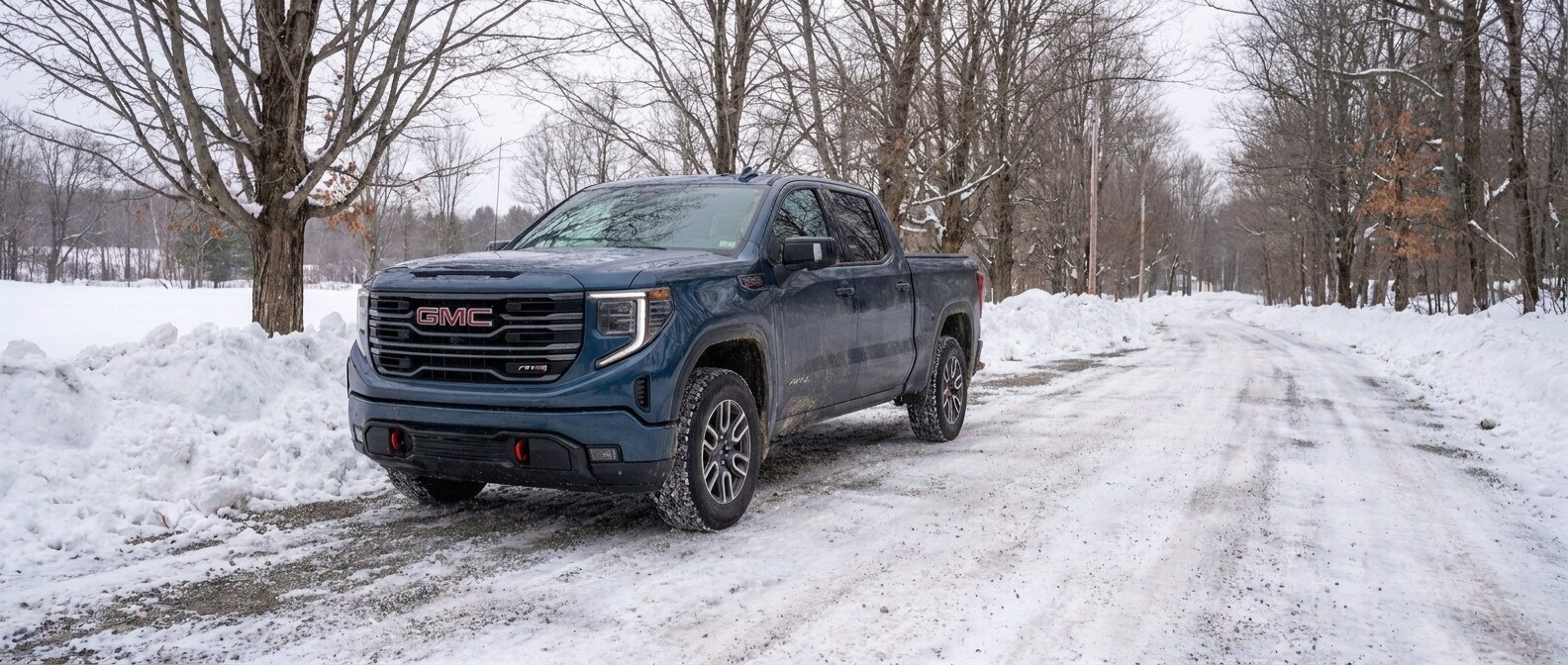
By the Brattleboro Auto Mall GMC Team | August 2026
Four engines. That's where a Sierra conversation should start, because the 2026 Sierra 1500 is really a family of configurations that behave very differently once the pavement ends. GMC lists the lineup as the 2.7L TurboMax four-cylinder at 310 horsepower and 430 lb-ft of torque, the 5.3L EcoTec3 V8 at 355 horsepower, the 6.2L EcoTec3 V8 at 420 horsepower, and the 3.0L Duramax turbo-diesel inline-six at 305 horsepower and 495 lb-ft. Torque is what you feel on a grade with a trailer behind you, and the diesel makes the most of it.
The 2.7L TurboMax delivers 430 lb-ft of torque, more than the 5.3L V8's 383 lb-ft, which is why the base engine handles a mid-size trailer far better than its cylinder count suggests.
Browse our Sierra 1500 inventory to see which configurations are on the lot, then use the sections below to narrow down what you actually need.
What the Specs Actually Mean Once You Leave Route 9
Tow ratings scale with engine, and the spread across the 2026 lineup is wide enough to decide your purchase on its own. Every figure below is a maximum for a properly equipped truck in its best configuration, so read them as ceilings rather than promises about the specific truck in your driveway.
| Engine | Output (GMC) | Max towing (GMC) | Where it fits here |
|---|---|---|---|
| 2.7L TurboMax I-4 | 310 hp / 430 lb-ft | 9,400 lbs | Daily driving, a small camper, a landscape trailer |
| 5.3L EcoTec3 V8 | 355 hp / 383 lb-ft | 11,200 lbs | The all-around pick; V8 response, no diesel upkeep |
| 6.2L EcoTec3 V8 | 420 hp / 460 lb-ft | 13,100 lbs | Heavy loads, frequent grades, maximum gas capability |
| 3.0L Duramax I-6 | 305 hp / 495 lb-ft | 13,300 lbs | Long tows over the mountains, best highway economy |
Maximum payload runs to roughly 2,230 pounds in a Regular Cab 2WD TurboMax build, and it's a number that falls as you add cab, drivetrain and trim. Here's the trade every truck buyer eventually meets: the Crew Cab that carries your crew is also the Crew Cab that carries less weight in the bed. Both numbers are honest, and they answer different questions. Pick the question that describes your week.
Every capability figure above applies only when the truck is properly equipped, per the published GMC capability guide. The authoritative limits for your specific truck are printed on its door-pillar label, and that label overrides any brochure, including this one.
On fuel, the 4WD 2.7L TurboMax is EPA-rated at 17 city and 20 highway. Four-wheel drive costs a mile or two per gallon against the same engine in 2WD across the lineup. That's a real expense over a year of commuting, and it's one most drivers around here accept for the reasons the next section covers.
Drivetrain Is the One Choice Vermont Makes for You
Take four-wheel drive. In most markets it's a preference; in Windham County it reads more like equipment. Vermont has roughly 8,700 miles of dirt roads, close to 55 percent of the state's total road mileage, and mud season runs from late March into early May when the frost leaves the ground and those roads go soft and rutted. A 2WD truck will get through April. It'll just work much harder doing it.
Winter makes the same argument twice. Our area averages roughly 48 to 56 inches of snow a year, with snow months stretching from October into April, and the climb west on Route 9 toward Hogback Mountain is where traction and engine braking earn their keep. Ground clearance and 4WD matter more on that road in February than any trim badge does. Ask anyone who plows.
If you tow, look hard at the diesel. The 3.0L Duramax carries the highest rating in the lineup at 13,300 pounds, and its 495 lb-ft of torque arrives low enough in the rev range to make a long grade uneventful. It also returns the best highway economy of the four engines, which starts to matter once your trailer miles are measured in hundreds rather than dozens.
If your trailer sits comfortably inside the 5.3L V8's 11,200-pound rating and you're mostly running local miles, that engine is the easier ownership story: no diesel exhaust fluid, no additional filters, and a maintenance routine you already understand. Our finance team can walk through the ownership math once you know which way you lean, and our service team handles diesel maintenance if that part is new to you.
The caveat we'd rather say out loud: four-wheel drive helps you go, and it does very little to help you stop. Traction control, 4WD and driver-assistance features are aids, not guarantees. On a salted grade in February, reduce your speed and increase your following distance no matter what's under the truck.
Get Pre-Approved for Your Sierra
Cab and Bed: Match the Configuration to the Week, Not the Weekend
Regular Cab, Double Cab and Crew Cab is a set of trade-offs rather than a ladder, and your cab choice quietly narrows your options before you've picked a single feature: the 2026 Sierra 1500 offers Crew Cab across every trim, Double Cab on Pro, SLE and Elevation, and Regular Cab only on Pro.
The pattern is honest and a little boring. Buyers who carry people choose the Crew Cab and give up bed length and payload. Buyers who carry material take the shorter cab and the longer bed, then wish for the back seat about twice a year. Decide from your Tuesday.
That framing sorts most of our customers quickly. A contractor running a two-person crew with tools riding in the bed is served very differently than a family towing a camper up to Mount Snow four times a season. One needs bed length and payload headroom; the other needs seats, a tow rating and a cabin people can stand for two hours.
- Crew Cab: four real doors and full rear seating, at the cost of bed length and some payload.
- Double Cab: the middle ground, with a longer bed and rear seats sized for occasional passengers.
- Regular Cab: maximum bed and payload, available only on the Pro trim.
- Trim note: the off-road-oriented trims add ground clearance and hardware that genuinely change how a truck handles a rutted town road in April. Around here that isn't cosmetic.
Who the 2026 Sierra 1500 Actually Fits
The Sierra 1500 is the right truck when your heaviest regular load lives inside its ratings and you want it to still make sense in year eight. For a rural family on dirt roads, a small-business owner hauling a landscape trailer, or a commuter running I-91 who tows on weekends, a 4WD Crew Cab with the 5.3L V8 covers nearly everything southern Vermont asks of a truck. That's the configuration we'd point most people toward first.
There's a real ceiling, though, and it's worth knowing before you sign. If your trailer regularly sits near the 1500's maximum, or you're carrying weight in the bed that pushes payload to its limit every week, the Sierra 2500 HD starts where the half-ton tops out. Running any truck at its limit as a routine is how you shorten its life, and the HD exists precisely so you don't have to.
Come drive one on real roads before you commit. We're glad to send you up Putney Road and back so you can feel the difference between the four-cylinder and the V8 instead of reading about it.
Sierra 1500 Questions Vermont Buyers Ask Us
Which 2026 Sierra 1500 engine is best for towing in Vermont?
The 3.0L Duramax turbo-diesel carries the highest rating in the lineup, up to 13,300 pounds when properly equipped, and its 495 lb-ft of torque makes long mountain grades easier. The 6.2L V8 is close behind at 13,100 pounds if you'd rather not own a diesel. Verify the limits for your specific truck on its door-pillar label.
Do I really need four-wheel drive on a Sierra 1500 in southern Vermont?
For most drivers here, yes. Close to 55 percent of Vermont's road mileage is unpaved, mud season runs from late March into early May, and snow months stretch from October into April. Four-wheel drive costs a mile or two per gallon against the same engine in 2WD, and that's the trade most owners in this area accept.
Categories:
Social