

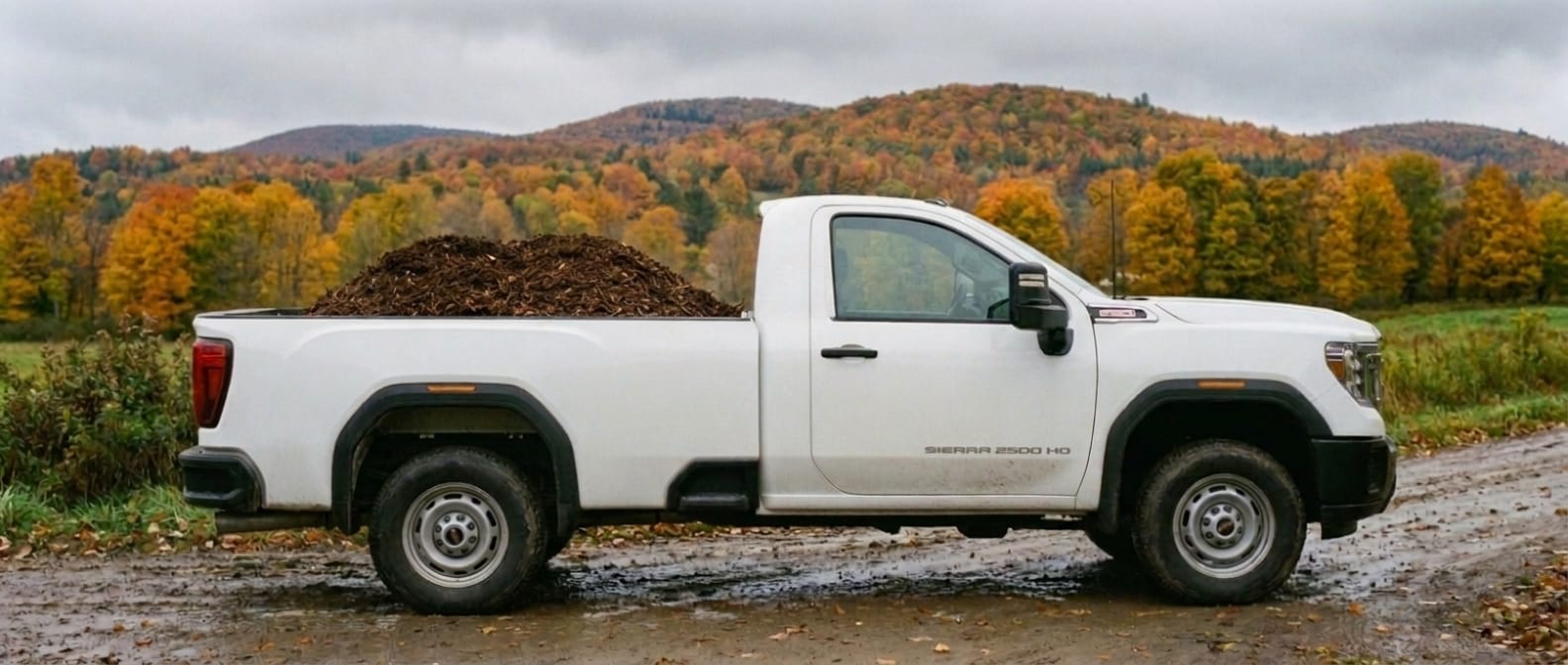
The sticker inside your driver's door frame tells you more than any brochure will. GMC publishes maximum payload figures for the 2026 Sierra lineup because they're genuinely impressive, and they are. But the number on your specific truck's door-pillar label is the one that actually governs your haul, and it's almost always lower than the published max. Knowing why, and how to work around it, separates a safe day hauling stone on Route 9 from a truck that rides wrong through every switchback.
Payload covers everything you put on or in the truck, meaning cargo, passengers, gear, and the tongue weight of any trailer, all measured against the certified limit on your door-pillar sticker. The published GMC maximum is an achievable ceiling you'll hit only under one specific configuration. Your truck has its own number.
The Sierra 1500 starts the conversation, but the right Sierra depends on what you're loading.
Will It Fit the Load?
Payload is the total weight your truck can carry beyond its own curb weight, and GMC calculates it as GVWR minus curb weight, a figure that covers the truck itself but nothing you choose to add to it. What trips up contractors and rural buyers is that "payload" includes every person riding in the cab, not only the material in the bed. Add three passengers at 200 pounds each and you've used 600 pounds before a single bag of stone goes in.
GMC lists the following published maximums for properly equipped 2026 Sierra configurations, per the GMC capability guide. Your actual truck's door-pillar sticker is the governing number for that specific VIN, and it's the only one that counts.
| Sierra Model / Config | Published Max Payload | What Reduces It | Fits a Common Southern VT Load? |
|---|---|---|---|
| Sierra 1500, Regular Cab, 2WD, 2.7L TurboMax | up to 2,230 lbs | 4WD drops it ~120 lbs; each passenger eats ~200 lbs | Cord of green wood (~2,000 lbs): tight, single occupant only |
| Sierra 1500, Crew Cab, Short Bed, 2WD | up to 2,020 lbs | Heavy trim adds weight; passengers cut fast | Half-cord split firewood (~1,000 lbs): comfortable with room for 2 passengers |
| Sierra 1500, Crew Cab, any trim, 4WD | ~1,710 to 1,980 lbs | Off-road trims (AT4X) drop to ~1,350 lbs | Mulch delivery (8 cu yd, ~1,600 lbs): match-up depends on your exact sticker |
| Sierra 2500HD, Regular Cab, Long Bed, 2WD, gas | up to 4,049 lbs | Diesel engine, 4WD, and larger cab all reduce it | Full pallet of bagged concrete (~2,500 lbs) + two crew: solid margin |
| Sierra 3500HD, Crew Cab, Long Bed, DRW, 4WD, gas | up to 6,378 lbs | Diesel DRW config rated at up to 5,647 lbs | Skid steer bucket attachment (~3,000 lbs) + crew + tools: designed exactly for this |
GMC notes that payload figures apply only when the truck is properly equipped, and that the actual limit is on the driver's door-pillar label for that specific truck and configuration. So you can't lean on the brochure alone. Check that label before you load.
Most spec sheets skip one thing entirely. If you're pulling a trailer, the tongue weight, typically 10 to 15 percent of loaded trailer weight per the GMC trailering guide, counts against your truck's payload just as if you'd thrown that weight in the bed. A 6,000-pound trailer running a 12-percent tongue load puts 720 pounds of payload budget on the hitch before you add a single tool to the bed. Plan for it.
How to Load a Sierra for a Vermont Work Run
Getting to your payload limit safely is partly a math problem and partly a loading problem, because where the weight sits in the bed changes how the truck behaves long before you reach the sticker number (or before any scale would flag you). How the load rides matters as much as what it weighs.
Weight centered between the wheel wells and distributed evenly side to side keeps the truck's suspension working as engineered. Stack everything against the cab and you'll lighten the rear. Pile it all at the tailgate end and your steering goes light through a mountain curve on Route 9. Neither is where you want to be on a descent.
The Sierra 1500's bed layout:
- Standard bed runs 79.44 inches long and 71.40 inches wide at the floor (50.63 inches between the wheel housings)
- Short bed measures 69.92 inches, an 8-inch difference that matters for full sheets of drywall and 8-foot lumber
- These dimensions come per GMC specifications
The Sierra 2500HD and Sierra 3500HD run longer beds and heavier-duty springs calibrated for sustained work loads, which means they don't wallow at or near their capacity the way a loaded 1500 can when you push the edge.
A practical habit our team sees reinforced by the GMC capability guide is a simple one. If you're hauling near your limit regularly, bring only the crew you need and leave non-essential gear out of the cab. Every person in that Crew Cab is payload.
Load check: Tongue weight from a trailer counts against your payload, not against a separate towing budget. A heavy fifth-wheel pin weight or a loaded gooseneck adds up fast on an HD that's already carrying material in the bed. Verify the combined weight against your door-pillar sticker before departure, not after.
- [ ] Locate and read your truck's door-pillar certification label (driver's side, inside the door frame)
- [ ] Subtract the weight of all passengers (use actual weights, not averages)
- [ ] Subtract any trailer tongue weight (roughly 10 to 15 percent of loaded trailer weight)
- [ ] Subtract the weight of any hitch or fifth-wheel hardware in the bed
- [ ] What remains is your available cargo budget for the bed
- [ ] Distribute cargo centered between the wheel wells and level side to side
- [ ] Never stack all weight against the cab or all weight at the tailgate
- [ ] After loading, walk around the truck: if the rear sits noticeably lower than normal on a 1500, you're near or past the suspension's designed range
Schedule a Pre-Haul Inspection
Matching the Right Sierra to Your Work
The Sierra 1500 handles most southern Vermont mixed-use work, and that's the honest tradeoff to weigh before you assume you need something bigger. Think half-cord firewood runs, landscape deliveries, a contractor's daily tools and a couple of crew members. What it doesn't cover is sustained payloads above 2,000 pounds on a daily basis without living at or near its limit, which is hard on springs, tires, and long-term durability.
Step up to the Sierra 2500HD, and it's built for exactly that gap. At up to 4,049 pounds in gas, Regular Cab, Long Bed, 2WD form, it handles a full pallet of concrete, a commercial mower, or a loaded utility trailer with meaningful margin left. The 6.6L V8 gas engine produces 401 horsepower and 464 lb-ft of torque and pairs with the Allison 10-speed automatic, per GMC specifications. The diesel option, the Duramax 6.6L turbodiesel, adds 975 lb-ft of torque and raises the 2500HD's max tow rating to 22,390 pounds when properly equipped, though the heavier engine drops payload relative to the gas configuration. For pure bed-load work, the gas engine often makes more sense. For sustained towing plus bed load combined, the diesel is the working answer.
The Sierra 3500HD in dual-rear-wheel configuration is a different category entirely. It's engineered for gooseneck and fifth-wheel work, heavy equipment transport, and applications where the 2500HD's ceiling isn't enough. If you're pulling a fully loaded equipment trailer up the grades west of Brattleboro toward Marlboro on a weekly basis, that's the truck the numbers point to.
Browse our current Sierra inventory to see which configurations are available, or call our team at (802) 347-1866. We can pull the door-pillar sticker data for any specific truck on our lot and match the actual rating to what you're planning to haul. That's how this works.
Job done. Payload specs here are sourced from the GMC capability guide and GMC.com for 2026 model year configurations, and you'll find the same numbers on our lot. The governing number is always the certification label on the driver's door pillar of your specific truck.