

Brattleboro gets close to 75 inches of snow in an average year. Route 9 west of town climbs out of the valley, tops out near 2,400 feet at Hogback Mountain, and gets restricted to passenger vehicles only when a serious storm rolls through. Last January, an 8-to-14-inch event closed the road to box trucks and trailers for the better part of two days. Your GMC truck or SUV can handle that run. Four-wheel drive gets you moving, but getting stopped is the harder half, and it won't help you there.
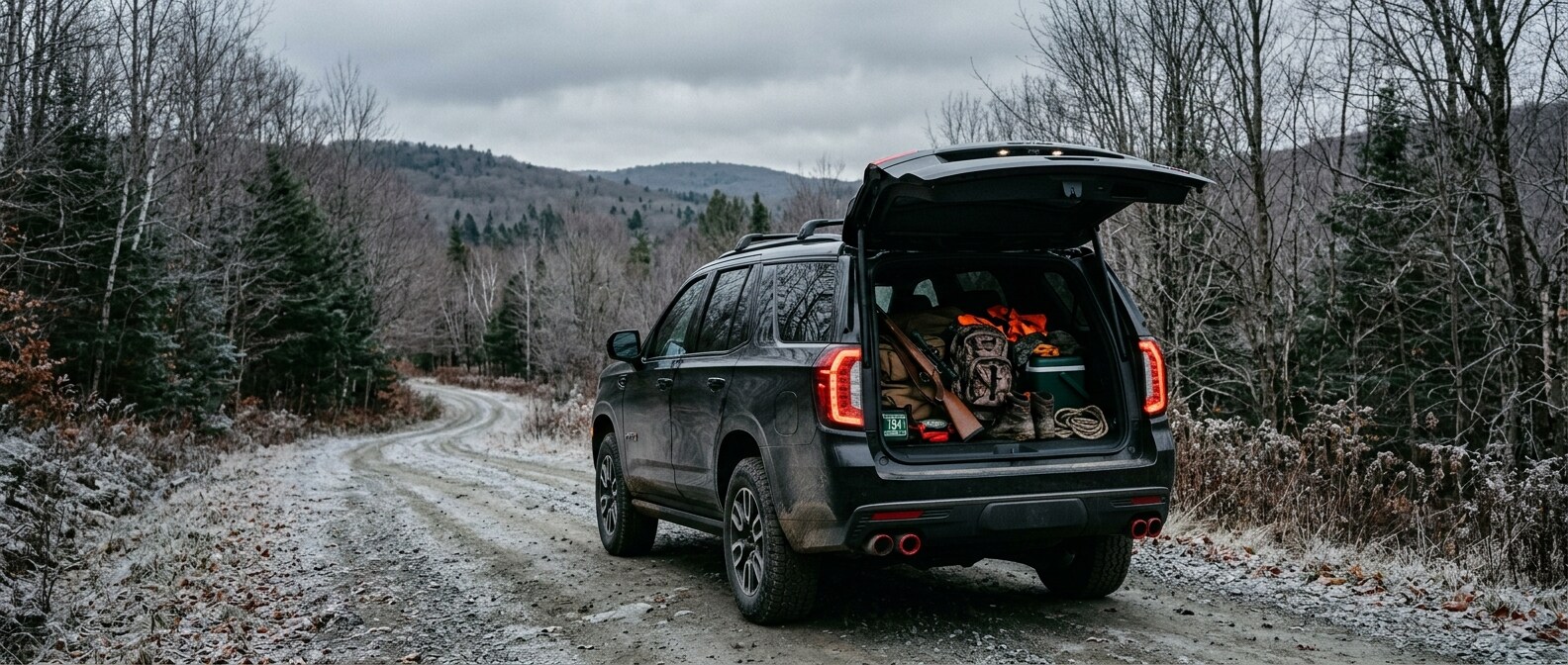
A full winter emergency kit fits easily in a Sierra bed or Yukon cargo area, and stowing it right adds real traction benefit to a rear-wheel-dominant pickup. We'll walk through exactly what goes in, where it stows, and how to drive it.
The Sierra 1500 is what we see most on Putney Road when the first real snow comes, so we'll anchor the numbers there. The same approach scales to the Yukon, Terrain, and every other GMC in the lineup.
Will Your Winter Kit Fit?
Yes, the whole kit fits, and it won't eat into cargo space you'd otherwise use on a work day, though the traction payoff depends entirely on where each piece lands in the bed. Below is how the most practical winter kit breaks down by item, weight, and stow location.
| Winter Kit Item | Approx. Weight | Stow Location | Notes |
|---|---|---|---|
| Ice scraper/brush (full-length) | under 2 lbs | Behind rear seat or in bed | Keep it reachable, not buried |
| Sand or non-clumping cat litter (25 lb bag) | 25 lbs | Forward in truck bed or trunk floor | Doubles as ballast; pour out if stuck |
| Folding shovel | 3-5 lbs | Under rear seat or behind tailgate | Sierra MultiPro Tailgate step-out ledge makes it easy to access |
| Jumper cables or jump pack | 2-6 lbs | Underseat storage cubby | Cold drains batteries fast; keep it dry |
| Wool blankets (2) | 4-5 lbs | Rear seat footwell or cargo bin | Folded flat, inside the cab where they stay dry |
| Flashlight plus spare batteries | 1 lb | Center console or glove box | LED holds charge in cold better than older types |
| Windshield washer fluid (1 gal, winter-rated) | 9 lbs | Bed or cargo area | Carry a spare; slush eats through a tank fast |
| Tow strap | 3-4 lbs | Under rear seat | For pulling out or accepting a pull |
| First-aid kit | 2 lbs | Glove box or center console | Replace expired items now |
| Phone charger / power bank | under 1 lb | Console or cup holder | Cell coverage goes thin past Marlboro |
| Total kit weight | ~55-60 lbs | Split between bed and cab | Well within any GMC payload rating |
The Sierra 1500's bed handles this kit without a second thought. A 2027 Crew Cab Short Bed 4WD Sierra carries a maximum payload of around 2,000 lbs. This kit barely registers against that number. Where you place it in the bed is what changes the outcome.
How to Load It for Real Traction
Load placement matters more on a 4WD pickup than on almost any other vehicle, since weight over the rear axle changes how hard your drive wheels bite, though you've still got to strap it down or it turns into a projectile. When a Sierra runs in rear-wheel or four-wheel drive, that weight improves contact patch pressure on the drive wheels.
That 25-lb bag of sand pulls double duty. It's emergency traction material if you get stuck, and it's a small but real contribution to planted rear tires on a slippery grade.
Place heavy items like sand, washer fluid, and the jump pack low and forward in the bed, centered between the wheel wells, and keep them secured. Blankets, the first-aid kit, and the charger live inside the cab where they stay dry and reachable.
Before every winter run west of town, confirm tire inflation. Cold air contracts, and a tire that read correct at 40 degrees will drop 1 to 2 PSI per 10-degree drop in temperature. Under-inflated tires lose traction and build heat in the sidewall, which is what leads to failure. Check the pressure placard on the driver's door jamb and hit those numbers before you leave.
Our service team sees this pattern every November, a truck still carrying September's summer pressures into December. On a wet grade that gap matters. The fix costs you nothing.
Knowing Your 4WD Modes on Southern Vermont Roads
Your Sierra hands you three distinct 4WD tools, and picking the one that fits the road does more for your safety than the drivetrain alone, as long as you remember that none of them shortens a stopping distance. We'll take them one at a time, from the mountain road down to the unplowed driveway.
4Hi is your road mode. On a mountain road in a storm, with snow moving and the surface plowed but slick, engage 4Hi. The transfer case sends torque to both axles, and you'll feel the difference on the uphill run. What 4Hi can't do is shorten your stopping distance. Four- and all-wheel drive improve traction in snow, not on ice. Every paved surface in Brattleboro can carry a sheet of black ice under three inches of fresh snow.
Leave more room than feels necessary. At highway speeds, stopping distance on packed snow roughly doubles compared to dry pavement. On a grade coming off the Hogback Mountain summit, the following distance you feel like you don't need is exactly the distance you'll want if the car ahead brakes hard.
4Lo belongs off the pavement. If you end up on a town road in Windham County that hasn't seen a plow, 4Lo gives you low-gear torque multiplication and much finer throttle control. It isn't a road-speed mode. Use it to creep through soft snow at a job site or a driveway, and keep it out of plowed-road work.
Never use cruise control. We tell everyone this, every season. On any surface with reduced traction, cruise control holds speed by applying power after you've already lost it. Turn it off and drive it yourself.
The 2027 Sierra 1500 Pro comes standard with a safety suite that includes Blind Zone Steering Assist and Intersection Automatic Emergency Braking. Those systems are genuinely useful on a winter morning when visibility is compressed. They're aids to an attentive driver, not substitutes for one (and they're standard equipment, not an upcharge).
Our current inventory includes the full 2027 Sierra 1500 lineup. The AT4 adds a 2-inch factory-installed lift and 34-inch all-terrain tires that give you measurably more options when conditions deteriorate.
Schedule a Winter Readiness Check
Your Pre-Storm Checklist Before You Head Out on Route 9
Run through this list the night before a storm, and you'll catch the small misses that turn a routine Route 9 run into a rough morning, though the one line worth guarding hardest is the extra time at the bottom. Print it or grab a screenshot so it rides along with you.
- [ ] Tire pressure checked and set to door-placard spec
- [ ] All windows, mirrors, lights, hood, and roof cleared of snow and ice, not just the driver's window
- [ ] Windshield washer fluid topped with winter-rated fluid
- [ ] Fuel tank at least half full
- [ ] Winter kit loaded in the bed, heavy items secured forward, low, and centered
- [ ] 4WD mode set: 4Hi for road travel, 4Lo only for off-pavement situations
- [ ] Cruise control off for the entire run
- [ ] Road conditions checked before departure at 511vt.com for Vermont
- [ ] Phone charged; charger in the console
- [ ] Extra time built into the schedule. That last one is not a suggestion.
Job Done: What You Carry Out of This
A verified 55-to-60-pound winter kit stows cleanly in a Sierra bed or Yukon cargo area, adds meaningful rear-axle weight on a pickup, and costs under an afternoon to assemble, though the gear only pays off if you drive to its limits too. Knowing 4Hi from 4Lo, and understanding that 4WD's limits show up under braking rather than acceleration, closes the gap between feeling capable and actually being capable on Route 9.
We carry the Sierra 2500 HD and the full GMC lineup at 800 Putney Rd. If your truck's due for a pre-winter check on tires, brakes, battery, and fluids, book it now before the first real storm moves in.
By the Brattleboro Auto Mall GMC Team | November 2026