

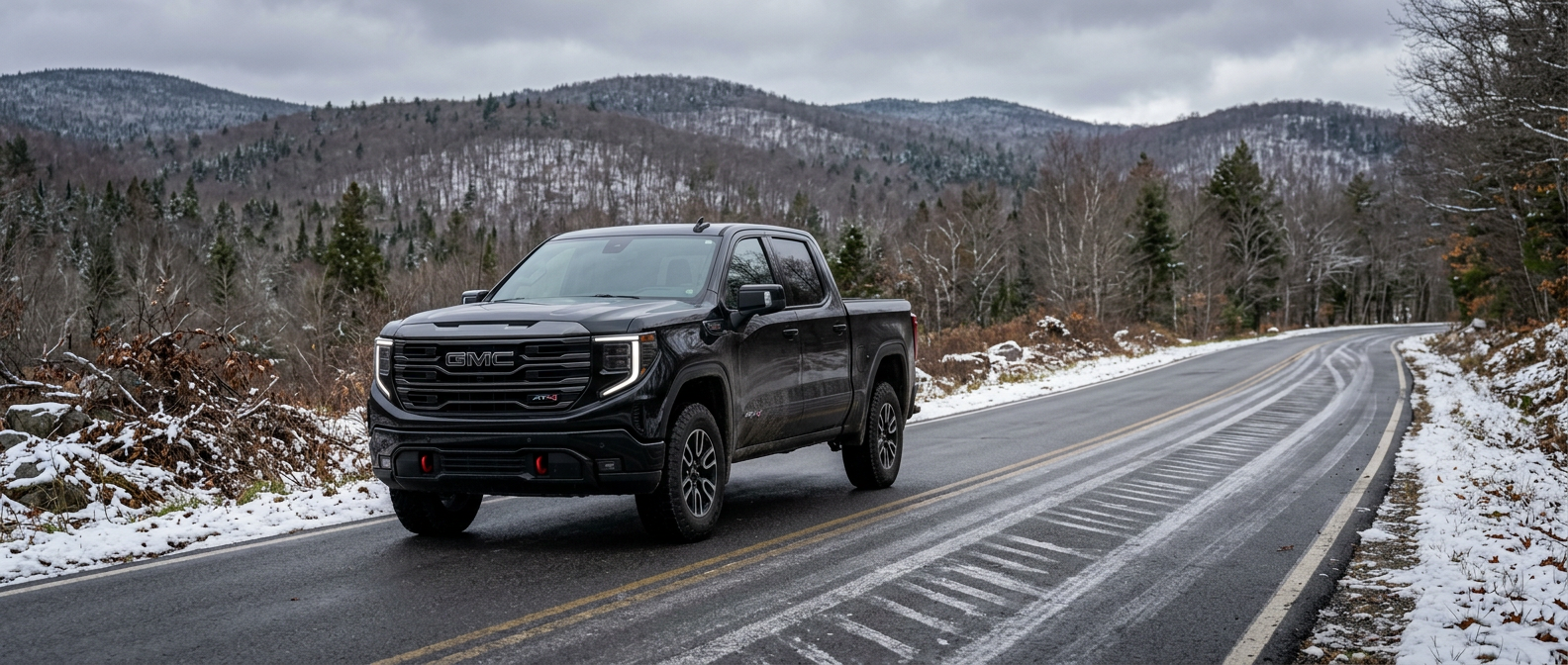
Most GMC 4WD owners in Vermont qualify for the severe-use service schedule before they ever realize it. Salt coats the roads from October through April, sustained grades on Route 9 keep the transfer case working hard, and mud season from late March into May punishes differentials and the undercarriage alike. That combination adds up fast. The Sierra 1500 is the truck we see most often in our service bay, and what surprises owners is how quickly southern Vermont's conditions push them out of the "normal" column and into the "severe" one for drivetrain fluid service.
Transfer case fluid is the clearest example. It's where this list starts.
The Five Priorities, Ranked
| Rank | Priority | Best For | Standout Spec or Interval |
|---|---|---|---|
| 1 | Transfer case fluid service | All 4WD Sierra, Canyon, Yukon | Severe use: every 50,000 miles vs. 100,000 normal |
| 2 | Differential fluid inspection | AT4, AT4X, locking-rear models | Inspect at 30,000-50,000 miles; towing and mud shorten that |
| 3 | Undercarriage wash and inspection | Every 4WD model in Vermont | Every 10-14 days during active salt season |
| 4 | Brake line and caliper inspection | All models, especially multi-winter trucks | Before first snow; again after mud season ends |
| 5 | 4WD engagement check and mode verification | Single-speed and two-speed transfer case models | Confirm before the first hard freeze each year |
Transfer Case Fluid Is the Most Overlooked Service on a Vermont GMC
The owner's manual for a 2026 Sierra 1500 lists two transfer case fluid intervals, every 100,000 miles under normal conditions and every 50,000 miles under severe use, and Vermont's roads push nearly every one of these trucks into the severe column well before the odometer suggests it. GMC's severe-use definition covers sustained operation on steep grades, frequent 4WD engagement, and driving in extreme temperature ranges. Route 9 west of Brattleboro checks all three. That road climbs to nearly 2,400 feet near Hogback Mountain in Marlboro, with sustained grades and tight curves, and a truck running 4WD High from Brattleboro toward Wilmington on a wet-snow morning is doing exactly the work the severe interval was written for.
The AT4 and AT4X trims use a two-speed Autotrac transfer case (GMC lists this as standard on the 2026 Sierra 1500 AT4), which gives you a proper 4WD Low setting on top of the automatic 4WD mode. That configuration suits this terrain. It also means more active engagement of the transfer case internals over time, which makes fluid condition a live variable rather than a calendar footnote. We read fluid by color and smell, beyond the mileage. Dark, metallic-smelling transfer case fluid at 45,000 miles on a Vermont truck isn't unusual around here. Change it then, no need to wait.
Differential Fluid Deserves Attention on Trucks with Locking Rears and Towing History
The 2026 Sierra 1500 AT4 comes standard with an automatic locking rear differential, and that component does real work in Vermont conditions, engaging the moment slip shows up and equalizing wheel speed across both rear wheels in mud, ice, and packed snow. Mud season in April, when frost leaves the ground and dirt town roads in Windham County turn soft and rutted, is exactly when that locker earns its keep.
GMC doesn't publish a fixed differential fluid change interval the way it does for the transfer case. Our practical guidance runs with the grain of standard drivetrain maintenance. Inspect the differential fluid every 30,000 to 50,000 miles, and shorten that window on trucks that tow often or spend time in mud or water crossings. The front differential fluid in particular tends to accumulate moisture, which shows as milky or dark discoloration when you pull the fill plug. A finding like that means a service call, not a crisis, though it needs handling before the fluid breaks down further.
For Sierra 2500 HD and Sierra 3500 HD owners running contractor or commercial schedules, the intervals compress further. The 2024 HD owner's manual specifies transfer case fluid at every 25,000 miles for severe use. If your 2500 or 3500 plows, tows a loaded flatbed in winter, or runs a service body year-round in Windham County, that 25,000-mile number is the one to track.
Undercarriage Washing Is Not Optional During Vermont Salt Season
AAA has documented the problem plainly, noting that road salt accelerates undercarriage corrosion and that such corrosion usually gets classified as normal wear and tear rather than a covered insurance claim. That distinction matters because the cost falls entirely on the owner, and not the insurer. Vermont's salt season starts in October and doesn't let up until late April. Call it roughly 25 to 26 weeks of active road salt exposure on every undercarriage component.
The schedule that protects the truck stays consistent. Wash the undercarriage every 10 to 14 days during active salt season, and within 24 to 48 hours after any significant salting event. A truck that only gets washed when the paint looks dirty on the outside is a truck whose owner hasn't looked at the frame rails, brake lines, or differential housings in a while. The damage accumulates without a sound.
The Yukon and Yukon XL carry a lot of undercarriage surface area. Wheel wells on a full-size SUV collect salt brine with ease. The same goes for a Sierra with skid plates. Those plates protect the oil pan and transfer case from rocks, but they can trap moisture and road spray against the underbody if nobody rinses behind them.
Winter Wash Caution: Don't wash the undercarriage when the temperature is below 32 degrees Fahrenheit. Water can freeze in brake caliper pistons, door seals, and lock cylinders. Wait for a day above freezing, then rinse thoroughly.
Brake Lines and Calipers Deserve a Dedicated Pre-Winter Inspection
Brake lines and calipers land fourth here because they tend to surface during a properly conducted oil change, provided your service advisor checks the right components, and that ranking says nothing about how much they matter in a Vermont winter. The state's combination of road salt and freeze-thaw cycling from below zero to well above freezing stresses brake line coatings and caliper slide pins in ways that don't show up in a short test drive.
Seized caliper slide pins are a common finding on trucks that have been through several Vermont winters. The symptom shows up as uneven pad wear, with one side of the axle wearing faster than the other because the caliper on the binding side isn't releasing cleanly. The fix is straightforward when caught early. Left unaddressed, it degrades braking performance and damages the rotor. Pre-winter is the right moment to catch it. Post-mud season (May) is the second logical checkpoint, since the thaw-and-salt combination from late March through April is genuinely hard on any metal component exposed to road spray.
The Annual 4WD Engagement Check Catches Problems Before You Need the System
Most 4WD problems stay quiet in a parking lot and only announce themselves on a February morning, the moment you engage 4WD High and hear something that wasn't there last spring, which is exactly why an annual engagement check earns its spot on this list. The engagement check is simple. Cycle through the modes in a controlled setting before the first hard freeze. Run 4WD Auto, 4WD High, and 4WD Low if your truck has the two-speed Autotrac transfer case. Confirm each one engages cleanly and that the display reads correctly.
On 2026 Sierra 1500 trims with a single-speed transfer case (Pro, SLE, Elevation, SLT), GMC provides Terrain Mode rather than a 4WD Low setting. Per GMC, Terrain Mode mimics the characteristics of 4WD Low at crawling speeds without the torque multiplication of a two-speed unit. Terrain Mode is a different system, and it deserves the same pre-winter engagement check. If anything feels hesitant or the mode indicator lags, book a service visit in October rather than December.
| Transfer Case System | Trims | What to Verify |
|---|---|---|
| Two-speed Autotrac (Sierra 1500 AT4/AT4X) | AT4, AT4X | 4WD High, 4WD Low, automatic 4WD mode |
| Single-speed with Terrain Mode (Sierra 1500) | Pro, SLE, Elevation, SLT | Terrain Mode engagement and mode indicator |
| Active Response 4WD (Yukon) | AT4, select trims | Torque distribution response in low-traction situations |
Pros and cons of following the severe-use schedule in Vermont:
| Pros | Cons |
|---|---|
| Correct interval for salt, grade, and mud conditions | More frequent service visits than the normal schedule |
| Catches degraded fluid before it causes drivetrain wear | Higher cumulative maintenance cost over the truck's life |
| Preserves drivetrain longevity through high-mileage years | Requires a tracked service log to stay on schedule |
| Prevents failures during the months you need 4WD most | Some service advisors under-apply severe-use triggers |
The Severe-Use Schedule Is the Right Standard for Windham County
The severe-use transfer case interval is the accurate standard for a GMC 4WD truck that runs Route 9 in winter, works dirt roads in mud season, and carries salt on its undercarriage from October through April, so treating it as a cautious upgrade misreads the conditions. Normal use is every 100,000 miles on a Sierra 1500 transfer case. Severe use is every 50,000. For a Sierra 2500 HD or 3500 HD working a commercial schedule, that drops to 25,000 miles under severe conditions. Vermont sits firmly in that column.
4WD maintenance is quiet until it isn't. The transfer case doesn't rattle when the fluid is degraded. Differential corrosion doesn't make noise. Salt on the frame works slowly. The owners who get year eight and year nine out of their trucks without drivetrain surprises are the ones who treat severe-use intervals as the default, not the exception, because for a Vermont truck, that's exactly what they are.
If you want our team to go through your GMC's 4WD system before the snow flies, bring it in. We'll give you a straight read on the transfer case, differentials, brakes, and undercarriage.
By the Brattleboro Auto Mall GMC Team | October 2026
Categories:
Service