

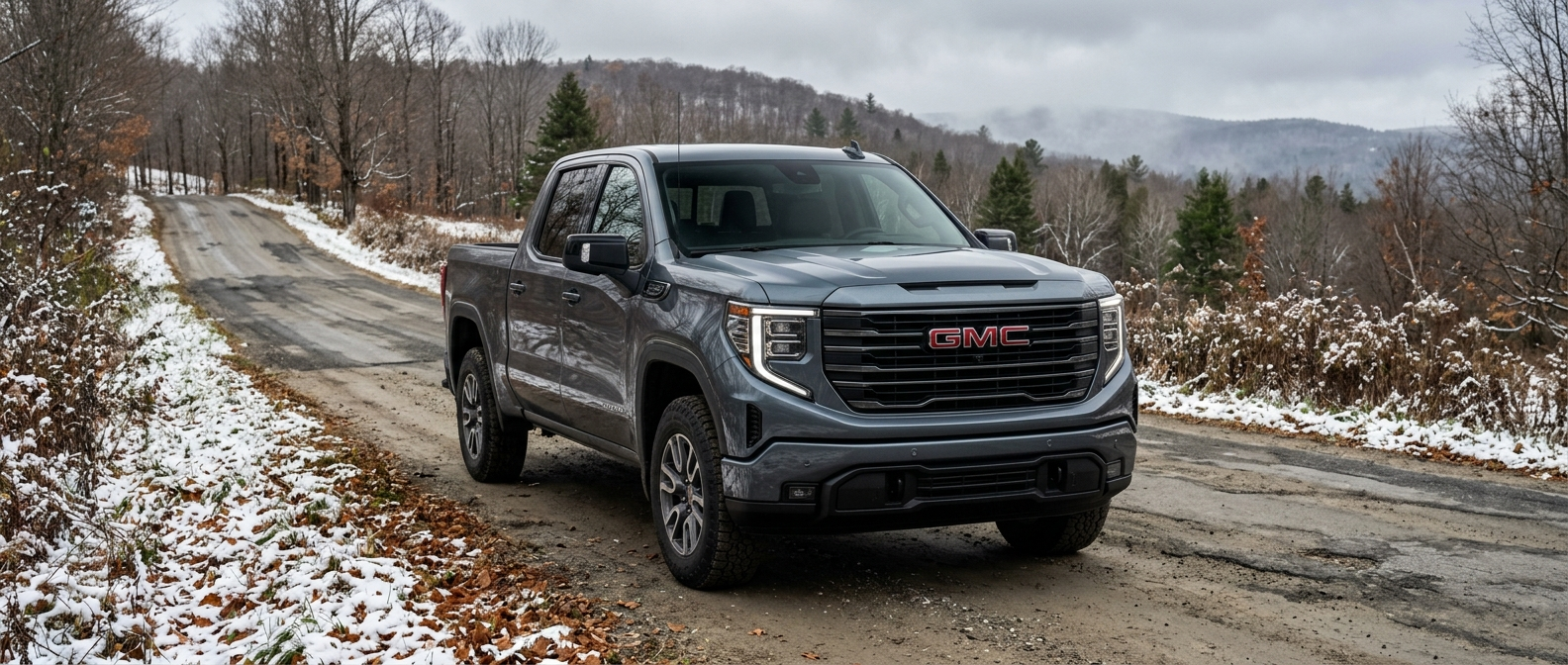
Every October we see the same thing roll through the service drive. A driver brings in a GMC that ran fine all summer, and a quick voltage test shows a battery that's been coasting on borrowed time since before mud season. The truck started. It always started. Then one January morning on Putney Road, it didn't.
You can avoid that scenario entirely. Modern GMC trucks and SUVs don't just need a battery. They need the right *type* of battery, and putting the wrong kind in can cause it to fail faster than the original ever would have, even in a mild climate. In southern Vermont, where Brattleboro averages around 56 inches of snow a year and January lows regularly reach the low teens, getting this wrong has consequences.
Modern GMC Sierra 1500 and Yukon models equipped with auto start-stop require an AGM (Absorbent Glass Mat) battery. A conventional flooded replacement will fail prematurely under the repeated cycling demands of the start-stop system. Verify your group size and cold cranking amp rating against your owner's manual before buying any replacement.
Browse the 2026 GMC Sierra 1500 if you're considering an upgrade or want to compare what's on our lot now.
What Do These Battery Specs Actually Mean for a Vermont Driver?
For a Vermont driver the spec that matters most isn't voltage but cold cranking amps, the measure of how many amps a 12-volt battery can deliver for 30 seconds at 0F while holding at least 7.2 volts. That's the exact scenario a Vermont truck faces on a January morning when the temperature has dropped overnight and the engine oil is thick.
Physics runs one direction here, and it's unforgiving. At 0F, a battery can lose up to 60 percent of its warm-weather output. Meanwhile, cold engine oil creates more resistance, so the starter needs *more* amperage at the exact moment the battery has *less* to give. CCA is the margin between "starts on the first turn" and "nothing."
Across the GMC models we sell and service at 800 Putney Rd, the specs stack up like this:
| GMC Model | OEM Battery Group | CCA Rating | Battery Type Required |
|---|---|---|---|
| Sierra 1500 (V8 / 2.7L Turbo) | Group 48 (H6) | 750-770 CCA | AGM required |
| Sierra 1500 (3.0L Duramax Diesel) | Group 49 (H8) | 900 CCA | AGM required |
| Yukon / Yukon XL | Group 94R (H7) or Group 49 (H8) | 850-900 CCA | AGM required |
| Terrain | Group 47 (H5) or Group 48 (H6) | 640-760 CCA | AGM required |
| Canyon | Group 48 (H6) | 750+ CCA | AGM required |
Every one of those models runs auto start-stop and carries an electrical load a flooded lead-acid battery wasn't designed to handle. Each time the engine shuts off at a light and restarts, the battery completes a partial charge-discharge cycle. AGM chemistry handles thousands of those cycles. A conventional flooded battery was built for the single daily start of an older, simpler engine. Put one in a start-stop Sierra and you're not saving money. You're shortening its life.
Consumer Reports notes that cold-weather drivers should target 600 CCA or higher as a floor. For a Sierra 1500 or Yukon in Vermont, the OEM specs clear that floor by a considerable margin, and for good reason.
The Vermont Factor: Why Our Climate Accelerates Battery Wear
Our climate wears a battery faster because three stresses pile up at once: deep cold plus heavy road salt plus the short-trip cycle that comes with a lot of rural and commuter driving. Every one of them chips away at the capacity the vehicle's electrical system leans on through a Vermont winter.
Brattleboro sits in southern Windham County. Its snowy season runs from roughly late October through mid-April, and town roads throughout the county get heavily salted. That salt migrates. It settles on battery terminals as fine white corrosion that slowly chokes the connection between the battery and the vehicle's electrical system. A corroded terminal can drop available voltage measurably, which means you can have a healthy battery that behaves like a weak one because the connection can't carry the load cleanly.
Short, repeated trips make it worse, and a lot of Vermont driving is exactly that. A battery that never gets a full recharge cycle degrades faster. A plow operator or contractor running a Sierra 2500 HD on a series of short lot-clearing runs in January is cycling the battery through partial discharges without ever letting the alternator bring it back to full capacity. Repeated partial-charge states accelerate sulfation inside the battery's plates.
In a demanding climate, the useful lifespan for a GMC battery runs 3 to 5 years, not 5 to 7. When we test a battery that's hitting year four in Vermont, we take the reading seriously even if the truck is starting normally.
Service note: A healthy GMC battery at rest reads between 12.4 and 12.7 volts with the engine off. A resting reading below 12.4V suggests the battery is significantly discharged or losing capacity. Below 12.0V, it's likely already failed internally.
See current 2026 GMC Yukon inventory if you're looking at a model with dual-battery or higher-demand electrical configurations.
View the 2026 GMC Terrain for Terrain-specific battery group and CCA details, or bring it in and we'll look it up for you.
Five Warning Signs That Show Up Before the No-Start
A failing GMC battery almost always gives you a window of warning before the no-start. The catch is that every one of those early signs is easy to brush off while the truck is still turning over and getting you to work.
- Slow crank on cold mornings. The engine turns over, but it takes an extra beat. That hesitation is the battery struggling to deliver amperage to the starter motor. It isn't a fluke.
- Headlights dim at idle, brighten when you rev. The battery isn't holding enough charge, so the vehicle leans hard on the alternator at low engine speeds to compensate.
- "Service Battery" or "Battery Saver Active" message. Modern GMC vehicles with the Driver Information Center surface these before a no-start condition. Don't clear the message and forget it.
- Electronics behaving oddly. The Sierra and Yukon run Forward Collision Alert, Lane Keep Assist, and Automatic Emergency Braking through control modules that require stable voltage. When voltage drops below threshold, those modules can throw fault codes or warning lights that have nothing to do with the actual safety system. The battery is the real issue.
- Corrosion on the terminals. White or bluish-grey powder at the terminal posts is an early sign of a connection problem that will eventually look like a battery failure.
Schedule a Battery Test Before Winter
Who Should Be Thinking About This Right Now
October is the right time to have this conversation. You want to catch a weak battery now and not in February, when the truck won't start, the temperature is single digits, and you have somewhere to be.
If your GMC is approaching its third or fourth year in Vermont service, a pre-winter battery test makes sense. If you bought a Sierra or Yukon used and aren't sure of the battery's age, a test is worth more than a guess. Our service team can load-test the battery and check the charging system to confirm whether the alternator is doing its job, or whether the battery is working harder than it should be to compensate for a weak charge.
There's one tradeoff worth naming. AGM batteries carry a higher upfront investment than a basic flooded replacement, and that part is real. We push back on the cheaper option for one reason. A flooded battery in a start-stop GMC is specifically mismatched to the job, and Vermont winters expose mismatches fast. A battery that fails at 18 months because it wasn't designed for start-stop cycling is no bargain.
For a scheduled service appointment, our technicians can confirm the correct group size, CCA rating, and battery type for your specific year and engine combination before we order anything. The door-pillar sticker and owner's manual carry the authoritative spec for your truck. That's what we check.
Frequently Asked Questions
Does my GMC Sierra or Yukon really need an AGM battery, or can I use a regular one?
Modern GMC Sierra and Yukon models equipped with auto start-stop systems require an AGM (Absorbent Glass Mat) battery. A conventional flooded battery is not designed to handle the repeated partial charge-discharge cycles that a start-stop system creates. Installing one will cause it to fail prematurely. If your vehicle originally came with an AGM, replace it with an AGM of the correct group size and CCA rating as specified in your owner's manual.
How cold does it have to get before a battery becomes a real risk in Vermont?
The battery's cold cranking amps (CCA) rating is measured at 0F, and that threshold is relevant in Brattleboro: January average lows run around 10 to 13F, and temperatures do drop below 0F in hard winters. At 0F, a battery can lose up to 60 percent of its warm-weather output while the engine simultaneously requires more power to turn over in cold oil. That's the scenario CCA is designed to address. For Sierra 1500 and Yukon owners in Vermont, the OEM specs of 750 to 900 CCA depending on the model and engine provide the necessary margin. FAQ:
Does my GMC Sierra or Yukon really need an AGM battery, or can I use a regular one?
Modern GMC Sierra and Yukon models equipped with auto start-stop systems require an AGM (Absorbent Glass Mat) battery. A conventional flooded battery is not designed to handle the repeated partial charge-discharge cycles that a start-stop system creates. Installing one will cause it to fail prematurely. If your vehicle originally came with an AGM, replace it with an AGM of the correct group size and CCA rating as specified in your owner's manual.
How cold does it have to get before a battery becomes a real risk in Vermont?
The battery's cold cranking amps (CCA) rating is measured at 0F, and that threshold is relevant in Brattleboro: January average lows run around 10 to 13F, and temperatures do drop below 0F in hard winters. At 0F, a battery can lose up to 60 percent of its warm-weather output while the engine simultaneously requires more power to turn over in cold oil. That's the scenario CCA is designed to address. For Sierra 1500 and Yukon owners in Vermont, the OEM specs of 750 to 900 CCA depending on the model and engine provide the necessary margin.