

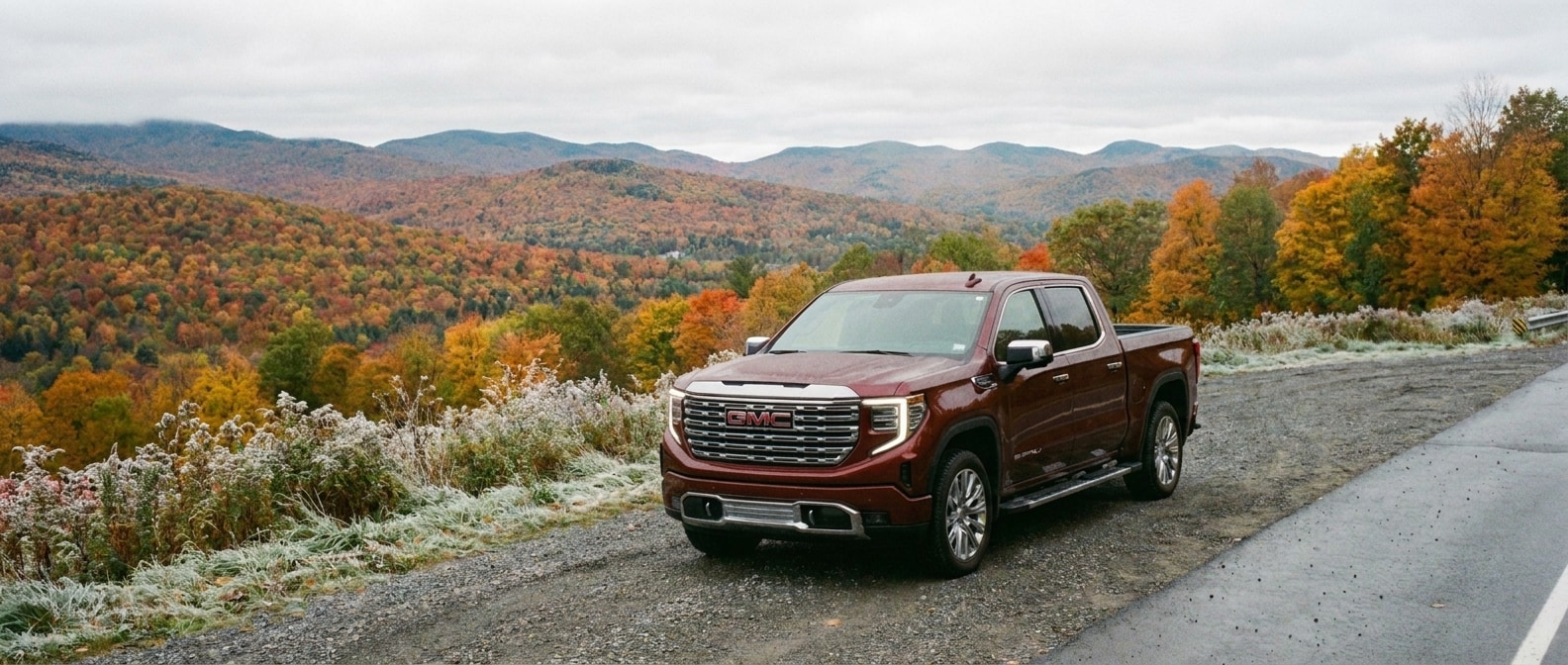
Route 9 from Brattleboro to Hogback Mountain runs 48 miles of sustained grades, tight pullouts, and October mornings that can drop below freezing at elevation before your coffee goes cold. Call that the straight version of the Molly Stark Scenic Byway in foliage season. Set your GMC up right before you leave 800 Putney Rd, and the drive turns into one of the best things you can do in a truck or SUV in New England. We'll walk you through how.
Southern Vermont's ridge elevations (Hogback sits at roughly 2,400 feet) start turning color in early October, while valley floors hold peak color through mid-to-late October. Set your vehicle up for both the temperature swings and the grades, not just the scenery.
Browse the 2026 GMC Sierra 1500 at Brattleboro Auto Mall GMC if you're planning to trailer a camper, a utility trailer, or a kayak rig for the trip.
What You Need Before You Start
Confirm every item on this list before you pull out of the driveway, because each one is quick at home and a real headache on the shoulder of Route 9. The table below is a fast reference, and the steps after it walk through the reasoning behind each line.
| Item | What to check | Why it matters on Route 9 |
|---|---|---|
| Tire pressure (cold) | OEM placard spec (driver door jamb) | Pressure drops roughly 1 PSI per 10 degrees F; October mornings at elevation run cold |
| Drive mode setting | 2H / Auto 4WD / AT4 terrain mode | Grades and leaf-slicked pavement change traction demands mid-drive |
| Trailer hitch and wiring | Security check + light test | Required before any fall tow; easier to fix at home than at a pullout |
| Cargo tie-downs | Straps tight, fragile items in cabin | Bed cargo shifts on switchbacks and grades |
| Engine coolant and oil level | Visual check at dipstick / reservoir | Extended grade climbs at elevated load stress cooling |
| Wiper blades | Streak-free wipe at low speed | Leaf debris and morning mist on windshields at elevation |
What takes ten minutes at home? Nearly all of it, and none of it takes ten minutes on the shoulder of Route 9 with a line of foliage traffic backed up behind you.
Five Steps to Set Up Your GMC for the Route 9 Run
These five steps are the how-to spine, and they hold whether you're in a 2026 GMC Terrain running Putney Road out to the byway or a Yukon with the third row full and a bike rack on the hitch. The logic doesn't change. Match the vehicle's systems to what the road actually asks of them.
Step 1. Set the right drive mode for the conditions you'll actually meet
Drive mode makes the biggest difference here, and it's the easy step to skip on a clear-looking morning that turns out to be anything but. The Molly Stark grades are real, since Route 9 gains and sheds elevation repeatedly across the 48-mile run between Brattleboro and Bennington. Morning frost at the Hogback overlook (about 2,400 feet) is possible from late September onward. Dry pavement at 10 a.m. on a Tuesday can be frost-slicked at 7 a.m. on a Saturday.
On the Sierra 1500, use Auto 4WD for the run. It applies 4WD torque only when slip is detected, so you're not burning extra fuel on dry stretches while staying covered for the frost-slicked grades and wet leaf patches. Save 4WD High for sustained grip conditions. The 2026 Sierra 1500's 2.7L TurboMax engine produces 430 lb-ft of torque and the truck carries 7.88 inches of ground clearance, so it handles Route 9's rougher pullouts and unpaved scenic access without drama.
On the Terrain AT4, GMC lists the AT4's twin-clutch AWD system and Terrain mode specifically for low-speed crawling over variable surfaces. On Route 9, Normal mode handles the highway stretches cleanly. Flip to Terrain mode for the unpaved trailhead pullouts or if you're exploring side roads off the byway. Hill Descent Control is available on AT4 and Denali trims. Use it on any extended downgrade where you'd otherwise be riding the brakes.
On the 2026 GMC Yukon, the optional 3.0L Duramax diesel produces up to 495 lb-ft of torque at low RPM. You feel that low-end pull on sustained climbs with a trailer behind you, and the transmission won't hunt for gears the way a gasoline engine can on a long, loaded grade.
The easy setup mistake: Setting 4WD High on clear, dry pavement and leaving it there. On 4WD vehicles without an Auto mode, 4WD High on dry pavement generates drivetrain binding through turns. If the road is dry and you don't need traction, run 2WD. Switch when conditions change.
Step 2. Weigh your load against your actual capacity (not the headline number)
Weigh your real load against the number stamped on your door jamb, since the brochure figure assumes a truck equipped exactly one way and yours may not be. GMC publishes capability figures for vehicles when they're "properly equipped," and that phrase carries more weight than it looks. Your specific truck's towing and payload limits live on the door-jamb label rather than the brochure. Check it before you hitch anything up.
With that in mind, the 2026 lineup sorts out like this for a fall trip with gear.
| Vehicle | Max tow (properly equipped) | Practical fall-trip use case |
|---|---|---|
| 2026 GMC Terrain | Up to 1,500 lbs | Lightweight utility trailer, kayak rack |
| 2026 GMC Acadia | Up to 5,000 lbs | Small camper, boat, utility trailer with gear |
| 2026 GMC Yukon | Up to 8,400 lbs (5.3L V8, Max Trailering Pkg) | Travel trailer, multi-horse, large boat |
| 2026 GMC Sierra 1500 | Up to 9,200 lbs (4WD) / 13,300 lbs (Duramax diesel) | Heavy camper, equipment, commercial trailer |
The 2026 GMC Acadia is worth a specific note here. Its 2.5L turbocharged four-cylinder produces 328 horsepower and 326 lb-ft of torque, and the Trailering Package comes standard across all trims. A 5,000-lb rating is plenty for the tandem-axle utility trailers, pop-up campers, and small boats that show up in Windham County fall traffic. Just remember that tongue weight counts against your payload rather than your tow rating. Load the trailer tongue-light and verify your actual numbers against the door-jamb sticker before you leave.
Step 3. Configure your cargo for the grades and turns ahead
Route 9's switchbacks and sustained grades will shift anything that isn't secured, so treat cargo like it wants to move. We walk through this setup before a foliage run.
- Bed cargo: all items strapped with ratchet straps anchored to the bed tie-downs. Even moderate loads can walk forward on a steep downgrade if they're just stacked in.
- Cab cargo: heavier items on the floor, not on seats. Waterproof gear bags over loose soft-sided bags.
- Cooler position: driver-side rear floor or trunk area (Terrain/Acadia/Yukon), not on the back seat. It slides otherwise.
- Camera equipment or optics: in a padded bag, in the cabin, period. The dirt-road pullouts off Route 9 are rougher than the byway itself.
- Emergency kit: blanket, tow strap, small battery jump kit, reflective triangles. October weather in the Green Mountains can go sideways fast. Pack it so you're the truck that helps someone else out of a jam.
- Fuel level: top off before you leave Brattleboro. There are stations along Route 9, but pullout timing in peak foliage traffic can be unpredictable.
Step 4. Run through the towing setup if you're pulling anything
If you're trailering, run this check at the dealership lot or in your driveway, well before the launch ramp or trailhead.
- Hitch ball size and class match the trailer coupler. Verify the class rating on the hitch receiver against your trailer's tongue weight.
- Safety chains crossed under the coupler. Crossed chains catch the tongue if the coupler separates, and straight chains won't.
- Wiring harness connected and light function confirmed. Walk to the back of the trailer: brake lights, turn signals, running lights.
- Weight distribution. Sixty to sixty-five percent of the trailer's cargo weight loaded in the front half of the trailer (forward of the axle).
- Trailer brake controller programmed if your trailer has electric brakes. The 2026 Sierra 1500 and Yukon integrate the controller; set the gain before you're on a grade.
- Side mirrors adjusted for trailer width. You need to see the trailer's rear corners from the driver's seat.
- Activate Tow/Haul mode. On both the Sierra 1500 and the Yukon, Tow/Haul adjusts the transmission shift points and engine braking to reduce grade-related shift cycling. Our service team can verify your trailer brake settings and wiring harness before you leave, if you haven't run this rig in a while.
Insider note: The ProGrade Trailering System on the Sierra 1500 includes up to 13 camera views. The trailer-side-view cameras are genuinely useful on Route 9's tight, switchback pullouts. Get familiar with those views in a parking lot before you're navigating a 40-foot pullout with traffic behind you.
Step 5. Pre-trip service check for October driving in Vermont
A pre-trip service check is the step that saves the trip, because southern Vermont winters start at elevation in October and the corrosion season from road salt is close behind. Run through this before a long foliage run.
- Tires: check tread depth and cold inflation pressure against the door-jamb placard. Tread matters; leaf-slicked pavement and frost-slicked grades reduce stopping distance meaningfully.
- Brakes: if you're towing, your brakes are working harder. A quick brake inspection tells you where you are.
- Battery: October cold starts at elevation are the first real battery stress of the season in Vermont. A load test takes minutes.
- Fluid levels: coolant, oil, and washer fluid. Grade climbing at load raises coolant temps, and leaf debris plus morning mist go through washer fluid faster than you expect.
- Undercarriage wash: if you towed over dirt roads or through mud season residue, now is a good time to flush salt and mud before winter prep begins.
Quick Recap Before You Head Out
If you've walked through all five steps, you're ready for Route 9, so print this recap or screenshot it and keep it handy for the morning you leave. The bold lines below are the fast version of everything above.
Drive mode: Auto 4WD or AWD engaged; Terrain mode ready for unpaved pullouts; Tow/Haul active if trailering. Tires: cold-inflated to placard spec; tread depth verified. Cargo: strapped, weighted low, camera gear in the cabin, emergency kit aboard. Fuel: topped off in Brattleboro before the byway. Trailer: ball/coupler matched, chains crossed, lights tested, brake controller set, Tow/Haul on. Service: tires, brakes, battery, and fluids checked before the trip, not after.
Southern Vermont's mid-to-late October peak is worth the setup time. The 48-mile Route 9 run across the Green Mountain National Forest to Hogback Mountain's 100-mile view is one of the genuinely great fall drives in New England, and your GMC handles it well when it's configured for what the road actually asks. The drive is the reward, and the setup is just how you get there without a story to tell at the service counter.