

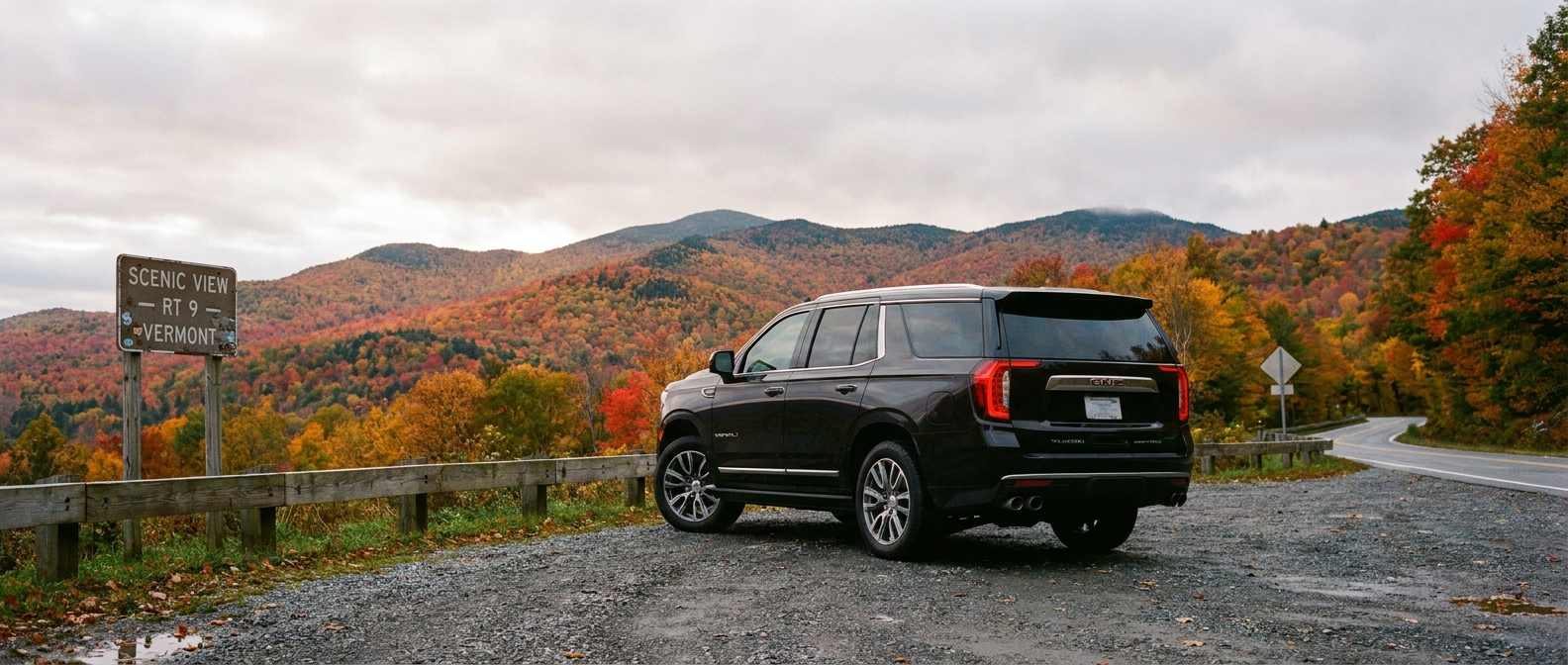
Yes, for most southern Vermont foliage trips the 2026 GMC Yukon is a strong fit. It seats eight, carries 25.5 cubic feet of cargo behind the third row, tows up to 8,400 pounds when properly equipped, and climbs the sustained grades of Route 9 through the Green Mountains without complaint. The question worth asking isn't whether it works. What matters is which configuration matches your actual family load.
Which Yukon Configuration Actually Fits a Vermont Foliage Trip?
Either body fits a southern Vermont fall run, but the standard Yukon suits most families of five to six, while the XL earns its extra length once every seat holds a person and every person brings a bag. Three rows, real mountain grades, and a trunk full of luggage are the conditions that separate a good road-trip SUV from a compromised one. Here's how the 2026 Yukon stacks up across the dimensions that matter on a southern Vermont fall run.
| Decision Factor | 2026 Yukon (Standard) | 2026 Yukon XL | Vermont Fall Context |
|---|---|---|---|
| Cargo behind 3rd row | 25.5 cu ft | 41.5 cu ft | Fitting gear for 3+ kids gets tight in the standard; XL gives real breathing room |
| Cargo (2nd row folded) | 72.5 cu ft | 93.6 cu ft | Overnight trips with a roof box push the standard to its limit |
| Overall length | 210 inches | 225 inches | Tighter in Brattleboro lots and village center parking; XL demands more attention |
| Max towing (properly equipped) | Up to 8,400 lbs | Up to 8,200 lbs | Relevant if you're pulling a camper or a boat trailer to the reservoir |
| EPA highway (5.3L V8) | 20 mpg | 20 mpg | Similar; diesel option improves highway to 26 mpg on either body |
| Mountain grade composure | Available Air Ride and Hill Descent Control | Same | Route 9 grades reward the adaptive suspension option |
| NHTSA overall safety rating | 5-star (all variants) | 5-star (all variants) | Consistent across the lineup |
The standard Yukon is the right size for most families taking a long weekend through Windham County. The XL earns its keep when you're carrying five or more adults plus real luggage, or when someone insists the camping gear rides inside the cabin instead of on a rack. Passenger count makes the call.
Browse Yukon XL inventory if your count consistently runs six passengers or more with overnight bags.
Which Engine Makes Sense for the Route 9 Run to Hogback Mountain?
For the Route 9 climb to Hogback Mountain, the 5.3L V8 moves a loaded Yukon up the grades without drama, while the available diesel makes the stronger case once you're covering real highway mileage across several days. Route 9 west of Brattleboro isn't flat. The Molly Stark Scenic Byway climbs toward Hogback Mountain in Marlboro (an overlook at roughly 2,400 feet that delivers a 100-mile panorama across southern Vermont, Massachusetts, and New Hampshire on a clear October morning). This overlook ranks among the most-trafficked stops in Windham County during foliage season, and it sits about 14 miles from our lot on a road with sustained grades and blind curves. The engine you choose makes that climb feel different.
The standard 5.3L V8 puts out 355 horsepower and 383 lb-ft of torque, enough to move a loaded Yukon up those grades without drama. It earns EPA estimates of 15 city / 20 highway. The 6.2L V8 bumps output to 420 horsepower and 460 lb-ft if you're towing a loaded trailer or want more in reserve on the descent. We've run both up Route 9.
The one worth pausing on is the available Duramax 3.0L Turbo-Diesel. GMC lists it at 305 horsepower but 495 lb-ft of torque (peak twist that arrives early and stays). The EPA rates the diesel-equipped Yukon at 21 city and 26 highway. On a multi-day foliage loop that covers real mileage, that efficiency gap adds up. There's a trade-off, though. The diesel costs more upfront, and you'll need a diesel pump, which is common on I-91 but less so on smaller Vermont back roads.
For a southern Vermont foliage trip with a full family load, the 5.3L V8 in 4WD is the honest default. Choose the diesel if you're covering serious highway mileage across multiple days. Choose the 6.2L if you're towing.
| 5.3L V8 | 6.2L V8 | Duramax 3.0L Diesel | |
|---|---|---|---|
| Horsepower | 355 hp | 420 hp | 305 hp |
| Torque | 383 lb-ft | 460 lb-ft | 495 lb-ft |
| EPA City / Hwy | 15 / 20 mpg | 15 / 20 mpg | 21 / 26 mpg |
| Best suited for | Most families, mixed driving | Towing heavy loads | Multi-day high-mileage trips |
The available Active Response 4WD system gives you real traction management on leaf-slicked pavement and wet grades (both genuine fall conditions in Windham County, not edge cases).
What Trim Makes the Most Sense for a Family That Actually Uses All Three Rows?
For a family that actually fills all three rows on a foliage trip, the trim choice comes down to ride quality and how much driving tech you want doing the work, and the 2026 Yukon gives you five steps to weigh (Elevation, AT4, Denali, AT4 Ultimate, and Denali Ultimate). Ride comfort on imperfect pavement and hands-free help are the two levers that matter most here.
The Elevation is the entry point, and it's no penalty box. Heated front seats and a heated steering wheel come standard, and the 16.8-inch infotainment screen with wireless Apple CarPlay is on board. For 2026, Super Cruise (GM's hands-free highway driving technology, compatible on mapped highways) became available on Elevation. The change matters, since earlier model years kept it in the higher trims only.
The AT4 adds Magnetic Ride Control, a skid plate, and red recovery hooks. We think the Magnetic Ride Control is genuinely underrated for Vermont roads. It reads the surface and adjusts the dampers continuously, which smooths the cabin over rough pavement and tar strips on rural town roads, the kind you hit constantly out here. We rate it highly out here.
Denali brings perforated leather surfaces in the second row plus available Air Ride Adaptive Suspension (four-corner height adjustment that flattens the ride on the highway and raises it when the terrain asks). The Denali Ultimate pairs that suspension with Super Cruise as standard.
The honest tradeoff comes down to how you drive. Go with the Elevation if ride quality on imperfect pavement isn't your priority and you're comfortable driving the route yourself. The AT4 earns its keep on any route with dirt roads or unpredictable surfaces. Denali suits families who want the quieter, more planted highway feel and the rear-row comfort to match.
| Trim | Best For | Tradeoff |
|---|---|---|
| Elevation | Most families, highway-heavy trips | Simpler suspension; Super Cruise now available |
| AT4 | Unpaved access roads, mixed terrain | Off-road oriented, not maximally polished |
| Denali | Long-haul comfort, three occupied rows | Higher investment; Air Ride on Ultimate only |
| Denali Ultimate | Full capability, hands-free highway driving | Top of the range in complexity and cost |
Considering a smaller footprint? The GMC Acadia is a three-row option that's easier to park in tighter Vermont village lots (a real consideration if your trip leans heavier on small-town stops than open highway).
Pros and Cons of Taking the Yukon on a Vermont Fall Road Trip
| Pros | Cons |
|---|---|
| Three full rows with real adult legroom | Standard-wheelbase cargo gets tight with 6+ people and full luggage |
| Up to 8,400 lbs towing (properly equipped) lets you bring the camper | 5.3L V8 at 15 city mpg means more fuel stops on village-heavy routes |
| Available Magnetic Ride Control smooths Vermont's rough pavement | XL's 225-inch length requires planning in tight village parking |
| NHTSA 5-star overall safety rating across all variants | Diesel efficiency gain requires confirmed diesel availability on your route |
| Available Hill Descent Control for mountain grade management | Air Ride Adaptive Suspension is trim-dependent, not standard across the lineup |
| Super Cruise now available on Elevation for 2026 | Overall size means planning for larger parking spots at popular foliage stops |
Is the 2026 Yukon Ready to Handle Vermont's Early-October Road Conditions?
Yes, the 2026 Yukon suits Vermont's early-October conditions, which land between summer and winter without ever quite being either. Early October in Windham County means something specific. Foliage peaks at lower elevations around the first week of October most years. The timing brings morning wet pavement, occasional road frost at elevation, and leaf debris on curves. Shoulder season, in short.
The Yukon's available 4WD system is calibrated for exactly that transition, surfaces that are wet and unpredictable but not snow-packed. Its Auto mode manages torque distribution without driver input, which helps when you're coming down a shaded hill on Route 9 with wet pavement, and traction control and stability control come standard across the lineup.
How much does tire condition matter before a foliage trip? More than it usually gets credit for, and it's the first thing our team checks before a fall run. The Yukon runs standard all-season tires across the lineup, and they handle early-fall conditions well. If your tires show significant wear before you leave, sort it before the trip, not after. Stopping distance on wet pavement increases measurably as tread depth drops.
The available ProGrade Trailering System, if you're towing, adds trailer-specific blind-spot monitoring and a Transparent Trailer View camera (useful on the narrower sections of Route 9 where you're watching for cyclists and oncoming traffic with a trailer in tow). Towing capability figures are published by GMC and apply only when the vehicle is properly equipped; verify the specific limits on your door-pillar label for the exact truck and configuration.
See available Yukon and Yukon XL inventory at Brattleboro Auto Mall GMC
Frequently Asked Questions
Is the GMC Yukon or the Yukon XL better for a Vermont family road trip?
For most families of five to six with a reasonable amount of luggage, the standard 2026 GMC Yukon works well. It carries 25.5 cubic feet behind the third row and seats up to eight. The Yukon XL adds 16 cubic feet behind the third row (41.5 total) and 15 inches of overall length, which makes a real difference when every seat is full and everyone's got a bag. If you regularly travel with six-plus passengers plus overnight gear, the XL is worth the longer footprint.
Does the GMC Yukon handle mountain grades on Route 9 in Vermont?
Yes. The 5.3L V8 produces 383 lb-ft of torque, enough to manage the sustained grades on the Molly Stark Scenic Byway without strain. Available Hill Descent Control helps on the downgrade side. And the available Magnetic Ride Control (standard on AT4 and Denali) continuously adjusts the suspension for the surface, which improves composure on the winding sections between Brattleboro and the Hogback Mountain overlook.
Which Yukon engine is best for a multi-day Vermont foliage road trip?
The answer depends on how far you're driving and whether you're towing. For a weekend loop through Windham County, the 5.3L V8 in 4WD is the straightforward choice. The Duramax 3.0L Turbo-Diesel earns its case on longer, highway-heavy trips because the EPA rates it at 21 city and 26 highway versus 15 and 20 for the V8 options. If you're pulling a camper or boat trailer, the 6.2L V8 at 420 horsepower and 460 lb-ft of torque is the towing-first pick. All figures are GMC-published and apply when the vehicle's properly equipped.