

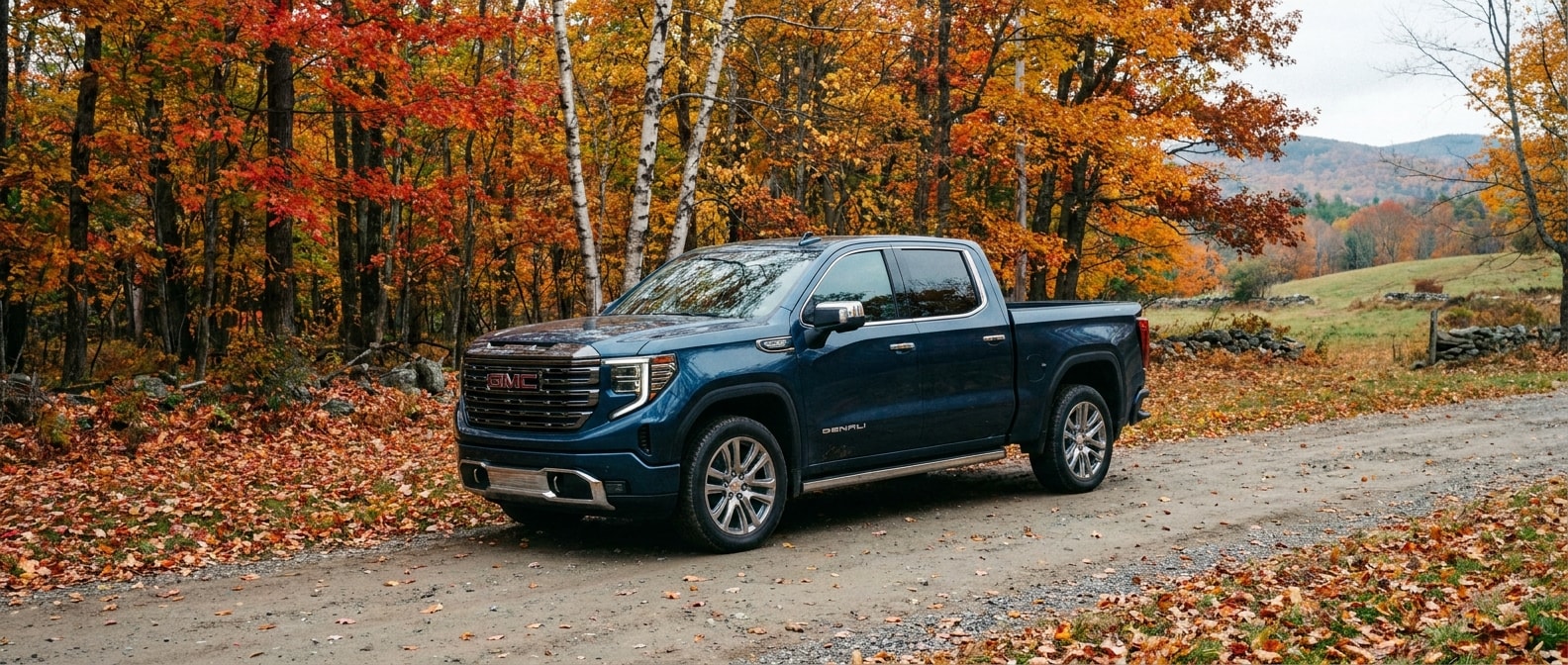
Late September is the right time to run this, and there's a practical reason. Foliage traffic is already building on Route 9. The Brattleboro to Hogback Mountain corridor is one of the most-traveled routes in Windham County right now, and the first dustings above 2,000 feet can arrive before October is out. That gives you roughly six weeks of prep window before conditions stop being merely wet and turn icy. Book your fall service appointment at Brattleboro Auto Mall GMC now and get ahead of it.
The checklist below is what our team works through every fall. It's built around how a GMC actually gets driven here: sustained descents, trailer loads, salted roads that show up earlier than the calendar suggests, and the way a Vermont commute to Keene or up I-91 toward Springfield looks in October compared to July.
What Goes on the Checklist?
The list runs ten items, and the order isn't arbitrary, so work it top to bottom; the first three matter most before the temperature drops below 45 degrees Fahrenheit, which is where tire pressure, brake fluid, and oil viscosity each start behaving differently in the cold.
Your GMC Fall Prep Checklist
- [ ] Tire tread depth (measure with a gauge or run the quarter test at each corner)
- [ ] Tire pressure (cold-check it in the morning before driving; TPMS reads hot pressure after a run)
- [ ] Oil life monitor (note the percentage displayed; schedule service if it's at or below 20%)
- [ ] Brake fluid condition (check the reservoir; dark or cloudy fluid needs flushing)
- [ ] Wiper blades (test on a wet windshield; if they streak, replace before foliage traffic builds)
- [ ] Cabin and engine air filters (a fall swap keeps leaves and road dust out of the HVAC)
- [ ] Headlights and taillights (check all lenses, including reverse lights, before the shorter days)
- [ ] 4WD or AWD function (engage and disengage the system in your driveway, not on a wet road)
- [ ] Battery condition (have it load-tested if the truck is three or more years old)
- [ ] Coolant level and concentration (a 50/50 mix protects to around minus 34 degrees Fahrenheit)
Why Each Item Earns Its Place
Tires come first because grip is the one thing no drivetrain can fake, and the legal tread minimum across most states, 2/32 of an inch, is a floor for staying legal rather than a safe target for Vermont fall driving in the wet and cold. NHTSA-cited testing shows that tires at 4/32 of an inch increase wet stopping distance significantly compared to new tires, and safety experts recommend 6/32 of an inch as the practical threshold for drivers who will see snow. If you're running the 265/70R17s spec'd on a Sierra 1500 or the 215/55R17s on a Terrain, check each corner separately. Rear tires on a rear-wheel-bias truck wear differently than fronts, and a single corner at 3/32 matters.
| Tread Depth | What It Means for Vermont Fall Driving |
|---|---|
| 6/32" or deeper | Adequate for wet roads and early snow entry |
| 4/32" | Replace before first snowfall (wet stopping distance is already compromised) |
| 2/32" | Legal minimum; not a safe target for wet or cold conditions |
For every 10-degree Fahrenheit temperature drop, tire pressure falls roughly one PSI, and your TPMS catches a big loss but not that gradual one-PSI-a-day bleed. GMC specifies cold inflation for the Terrain at 33 PSI front and rear, the Sierra 1500 base spec runs 35 PSI, so check both on a cold morning before you've driven anywhere.
The Oil Life Monitor doesn't count miles. GMC's system tracks engine revolutions, operating temperatures, and idle time to calculate actual oil degradation. Cold-start cycles in October tax oil faster than a summer highway run. The system alerts you within 600 miles of GMC's published 7,500-mile or 12-month service interval under normal conditions. If your display shows 20 percent or below today, book the service. That's your cue.
In hill country, brake fluid earns more attention than a routine checklist gives it. DOT 3 fluid is hygroscopic (it absorbs moisture over time, and that moisture lowers the boiling point). A sustained descent like the Route 9 grade west of Brattleboro generates real heat in the calipers. GMC's service guidance recommends evaluating brake fluid around the three-year or 45,000-mile mark. Dark or cloudy fluid in the reservoir is a reliable sign it's overdue.
Yukon owners have one more fall-specific task, and it's a quick one. Inspect the third-row seals and lift-gate weatherstripping. Wet leaves pack into those gaps and hold moisture against the metal through winter. Ten minutes with a silicone seal treatment now prevents a harder problem in March.
4WD Engagement Check Engage your transfer case from 2WD into 4-High at low speed on dry pavement before you need it in slick conditions. You're confirming the shift is clean and the indicator reads correctly. 4WD, AWD, traction control, and driver-assistance features are all driving aids. Reduce speed and increase following distance in wet and wintry conditions regardless of drivetrain.
Schedule Your Fall GMC Service
The Why Behind Each Check (Quick Reference)
| Checklist Item | Why It Matters for This Region |
|---|---|
| Tread depth at 6/32" for snow | Windham County sees snow from October into April; foliage rain arrives first |
| Oil life monitor percentage | Cold starts and short commutes degrade oil faster than mileage alone suggests |
| Brake fluid condition | Route 9 grades generate caliper heat (absorbed moisture lowers the boiling point) |
| 4WD or AWD function test | Confirm the system before first frost, not during it |
| Battery load test | Cold cranking demand rises sharply below 32 degrees Fahrenheit |
| Wiper blade condition | Foliage mist and leaf tannins on glass wear blades harder than summer rain |
Print-and-Go Recap: Three Questions Before Mid-October
The full checklist collapses into three questions if you're short on time, and any "not sure" answer is your starting point rather than a reason to put the visit off until the weather has already turned on you for the season. Are my tires at 6/32 of an inch or better? Has the Oil Life Monitor been checked and service booked if it's below 20 percent? Have I physically engaged the 4WD system at least once since spring?
If any answer is "not sure," that's where to begin. Our service team runs a multi-point inspection with every visit, covering tires, brakes, battery, filters, and fluids in one stop. Book your appointment at brattautomall.com/service.htm and use the fall window before it closes.
Anyone running a Sierra 2500 HD, Sierra 3500 HD, or Savana Cutaway 4500 through the fall work season should note that GMC's capability figures apply only when properly equipped. Verify your truck's actual payload and tow ratings on the door-pillar label before the season changes. The published GMC capability guide is the starting reference, and it's the label on your specific truck that governs that configuration.
Frequently Asked Questions
Will my TPMS warn me when pressure drops in October?
Your TPMS triggers when pressure falls roughly 25 percent below the vehicle's recommended cold inflation. On a Sierra 1500 spec'd at 35 PSI, that's around 26 PSI or lower. It won't flag the gradual one-PSI-per-10-degree drop that October mornings produce. That's why a manual cold-pressure check at the start of fall is worth doing even when no warning light is on.
Do I need dedicated winter tires if my GMC has 4WD or AWD?
4WD and AWD help with acceleration traction. They don't shorten stopping distance, which the tires themselves control. All-season tires harden noticeably below 45 degrees Fahrenheit, which cuts grip on cold wet pavement and snow. Dedicated winter tires use a compound that stays pliable in the cold. If you'll put significant miles on Route 9 or dirt town roads from November onward, especially with current all-seasons approaching 4/32, a winter tire set is worth a real conversation with our team.
Categories:
Social