

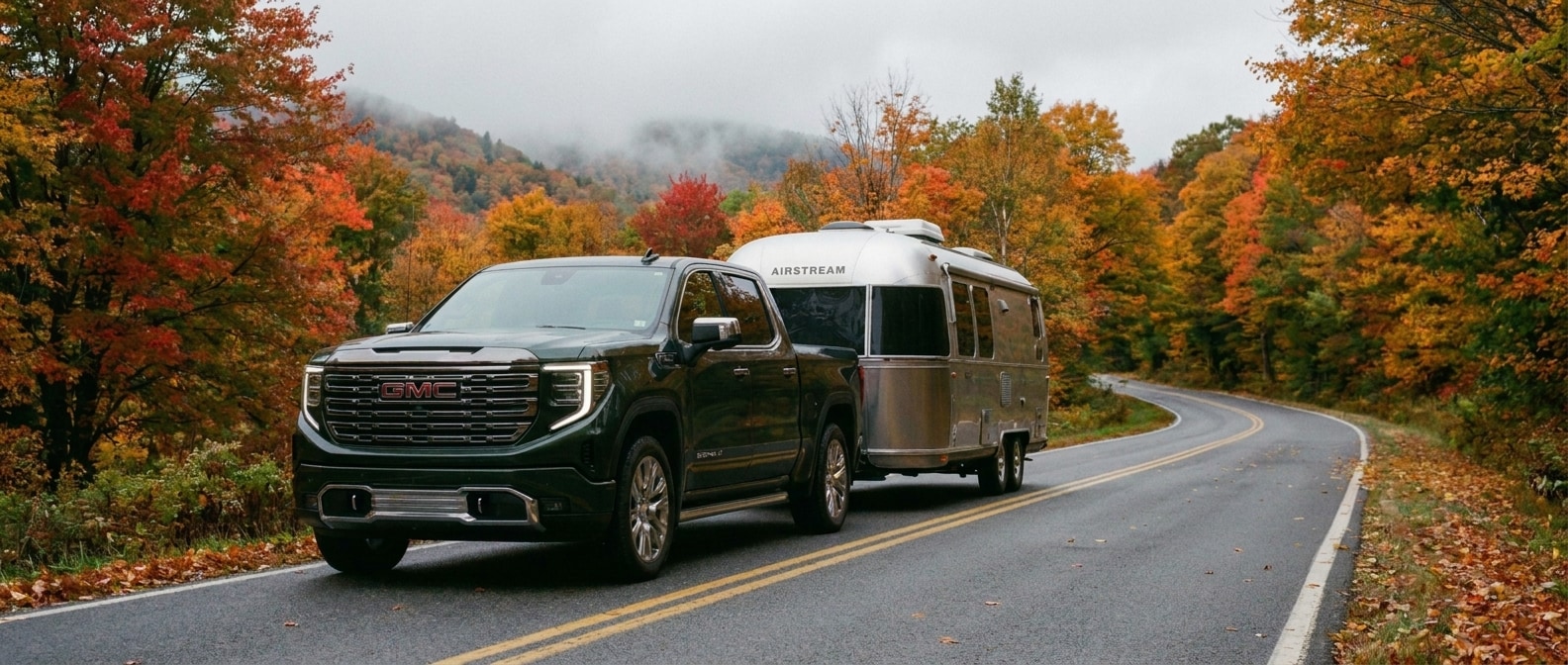
From late September through mid-October, fall camping season in southern Vermont asks more of a truck than summer ever does. Leaves come down and Route 9 turns slick. Overnight temperatures drop into the low 40s, and the grades between Brattleboro and Hogback Mountain (roughly 2,400 feet at the overlook) won't forgive an underpowered or overloaded setup.
A fair question before a first tow, or a step up to a bigger trailer, is which Sierra you actually need. We carry three distinct answers on our lot. The GMC Canyon, the Sierra 1500, and the Sierra 2500 HD don't serve the same buyer. Get that wrong and you either leave capability on the table or spend more truck than your trailer requires.
The short version
- Canyon (up to 7,700 lbs towing): the right fit for pop-up campers, lightweight travel trailers under 6,500 lbs, and buyers who want a maneuverable truck year-round. It won't move a fifth wheel.
- Sierra 1500 (up to 13,300 lbs towing, properly equipped): the most versatile option for most Vermont campers (daily driver and weekend tower); handles mid-size travel trailers and toy haulers with the 5.3L or diesel, and doubles as a capable four-season daily driver.
- Sierra 2500 HD (up to 20,000 lbs conventional towing): built for fifth wheels and heavy bumper-pull rigs. More truck than most campers need, but the one you want if your loaded trailer pushes past 12,000 lbs.
- The local angle: Route 9's sustained grades and October slick roads shift the math. A Sierra 1500 with the Duramax diesel and 4WD holds composure on that run; the Canyon does too for lighter rigs, but leaves less margin on the grade.
- Payload is where the surprises live: tongue weight counts against your payload, not your tow rating. Check your door-jamb sticker before you load, not after.
How Do These Three Trucks Actually Compare?
Tow ratings tell part of the story, but payload, terrain, and the ProGrade Trailering System fill in the rest of it. Look at the whole picture and the three trucks separate cleanly.
| Truck | Max Towing (properly equipped) | Max Payload (approx.) | Best Trailer Match | Best For |
|---|---|---|---|---|
| Canyon | 7,700 lbs | ~1,640 lbs | Pop-ups, small travel trailers | Compact rig, tight campsite access |
| Sierra 1500 | 13,300 lbs (diesel) / 11,800 lbs (5.3L V8) | ~2,240 lbs | Mid-size travel trailers, toy haulers | Most Vermont campers (daily driver and weekend tower) |
| Sierra 2500 HD | 20,000 lbs conventional | ~3,863 lbs | Fifth wheels, large bumper-pull rigs | Heavy rigs, seasonal or dedicated tow truck |
GMC publishes the full trailering guide with configuration-specific figures. Those capability numbers only apply when the truck is properly equipped. Your specific vehicle's real limit lives on the door-pillar sticker. That's the number to trust.
Payload and towing capacity aren't the same thing. Tongue weight (roughly 10-15% of trailer weight) counts against your payload. Load a Sierra 1500 with three adults, a bed full of gear, and a 900-lb tongue weight, and you can run close to the payload limit before the trailer even moves.
What Does Your Trailer Actually Weigh, and Which Truck Does That Demand?
Start with the loaded weight, because that single number decides more of this choice than any brochure figure does. The dry weight is easy to find. The loaded weight is the one that gets overlooked, and the full picture (tongue weight plus passengers plus camping gear) rarely gets tallied until we work through it together on the floor.
The common camping rigs break down by weight class about like this.
- Pop-up campers and small folding trailers: typically 1,500 to 3,500 lbs loaded. The Canyon handles these cleanly with headroom to spare.
- Entry-level hardside travel trailers (18-22 feet): loaded weights commonly run 5,000 to 7,500 lbs. The Canyon covers the lighter end; the Sierra 1500 (even with the 2.7L TurboMax, rated up to 9,400 lbs when properly equipped) gives you real margin.
- Mid-size travel trailers and toy haulers (23-28 feet): loaded at 8,000 to 11,000 lbs. This is the Sierra 1500's main territory. The 5.3L V8 at up to 11,800 lbs, or the 3.0L Duramax diesel at up to 13,300 lbs, covers the whole category with the right configuration.
- Large bumper-pull rigs and fifth wheels: loaded weights from 12,000 to 18,000 lbs. This is Sierra 2500 HD territory. GMC rates the 2026 Sierra 2500 HD at up to 20,000 lbs of conventional towing with the 6.6L Duramax diesel (470 horsepower, 975 lb-ft of torque) when properly equipped.
The Canyon's tradeoff is real. It's a genuinely capable midsize truck, and it's easier to park at a crowded foliage-season campground than a crew-cab long-bed. But it can't run a fifth wheel, and it won't give you the payload margin a Sierra 1500 does once four people and a full week of gear get into the equation.
Schedule a Pre-Trip Service Check
Does the Route 9 Grade Change the Calculation?
Yes, and by more than a flat-interstate mindset would suggest, because a sustained climb under load stresses a transmission and a brake system in ways cruising never reveals. On level ground the Canyon and a lighter travel trailer are a relaxed pairing. Route 9 west out of Brattleboro isn't flat. The Molly Stark Scenic Byway climbs steadily toward the Hogback Mountain overlook, and sustained grades under load work a drivetrain differently than highway miles do.
The Sierra 1500's available 3.0L Duramax diesel engine earns its reputation on exactly this kind of terrain. Diesel torque (GMC lists 495 lb-ft for the Duramax) arrives down low, which is where a sustained climb actually lives. You're not hunting the powerband on the way up, and engine braking on the descent stays more predictable. Fall mornings on Route 9 can bring leaf litter and damp pavement. Tow/Haul mode, available on both the Sierra 1500 and Sierra 2500 HD, adjusts shift points and boosts engine braking to keep you composed on the grade.
Both the Sierra 1500 and Canyon offer 4WD. It's standard on most Canyon trims above the base Elevation and available in multiple configurations on the Sierra 1500.
Now, 4WD isn't a substitute for speed management and following distance on a wet descent. What it does is widen the margin between the truck doing its job and the driver working hard to compensate.
A practical note from our service side. If you're pulling a trailer over Hogback and back in October, your brake fluid condition, tire wear, and hitch hardware (torque on the ball mount, safety chain condition) all matter more on that road than they do on I-91. Fall's a good time to run through the checklist, well before you load up.
What the ProGrade Trailering System Adds
The ProGrade Trailering System earns its keep in the situation that rattles new towers most, which is backing a rig into a tight Vermont campground with narrow lanes, trees close on both sides, and uneven ground under the wheels. More camera angles help there. Helpful bystanders, less so.
On the Sierra 1500, the available ProGrade Trailering System addresses that directly. It includes 15 or more available camera views with hitch guidance overlay, custom trailer profiles that save your brake and lighting settings, pre-departure checklists, and an integrated trailer brake controller that works with the truck's own ABS. Set up your trailer profile once, and the system walks you through the checklist on every trip after that.
The Sierra 2500 HD carries the same system with additional viewing angles suited to larger rigs, including transparent trailer view on select trims. The Canyon includes a simpler trailering package (Tow/Haul mode and an available integrated trailer brake controller), but without the full ProGrade camera suite.
If you're new to towing, that camera suite on the Sierra 1500 is a real argument for it over the Canyon even when your trailer sits technically within the Canyon's rating. Solo hitching without a spotter is genuinely easier.
Which Truck Fits Which Southern Vermont Camper?
Match the truck to your loaded trailer weight and the roads you actually drive, and the choice mostly sorts itself out, with the Canyon at the light end, the Sierra 1500 across the broad middle, and the 2500 HD for the heavy rigs that need it.
Pick the Canyon if your trailer consistently runs under 6,500 lbs loaded, you want something more practical around Brattleboro and Keene day-to-day, and fifth-wheel capability isn't on your horizon. It's a clean, capable midsize truck. It just has limits, and they're worth knowing before you buy.
Pick the Sierra 1500 if you're towing a mid-size travel trailer or toy hauler anywhere from 7,000 to 12,000 lbs, you want 4WD composure for four-season southern Vermont use, and you need a truck that works on Putney Road on a Tuesday and pulls a loaded camper up Route 9 on a Saturday. For four-season use in Windham County, the Sierra 1500 is the answer that fits the widest range of camping setups.
Pick the Sierra 2500 HD if you're running a fifth wheel, your loaded rig regularly tops 12,000 lbs, or you're also putting the truck to work on the job. The extra capability doesn't come free (the 2500 HD is heavier, longer, and uses more fuel), but if your trailer demands it, you want the margin, no way around it.
One configuration note that matters for fall. If you're speccing a Sierra 1500, the Max Trailering Package (RPO code NHT) adds heavier-duty rear springs, enhanced cooling, revised shock tuning, a high-output alternator, and a strengthened rear axle. Those aren't paper upgrades. On a loaded trailer and a sustained grade, they're the difference between the drivetrain working comfortably and working hard.
Frequently Asked Questions
Which GMC truck is best for pulling a travel trailer in Vermont?
The Sierra 1500 is the right choice for most travel trailer towing in southern Vermont. With the 5.3L V8, it's rated up to 11,800 lbs when properly equipped; with the available 3.0L Duramax diesel, that climbs to 13,300 lbs. The diesel's torque delivery suits sustained grades like Route 9 west out of Brattleboro, where low-RPM pulling power matters more than peak horsepower. The Canyon handles smaller rigs (under roughly 6,500 lbs loaded) with ease, and the Sierra 2500 HD covers fifth wheels and heavy bumper-pull rigs above 12,000 lbs. Verify the exact rating for your specific build on the door-pillar sticker, and confirm the loaded weight of your trailer before you finalize a configuration.
Do I actually need the Sierra 2500 HD for a fifth wheel camper?
For most fifth-wheel trailers, yes. Fifth-wheel hitches mount in the bed and distribute weight differently than a conventional ball hitch. The Sierra 2500 HD with the 6.6L Duramax diesel is rated for up to 20,000 lbs of conventional towing and considerably more with a fifth-wheel or gooseneck setup when properly equipped. The Sierra 1500 can tow a fifth-wheel trailer in some configurations (GMC lists up to 9,900 lbs with a customer-installed fifth-wheel hitch on the 1500), but for a full-size fifth-wheel camper running 12,000 lbs or more loaded, the 2500 HD gives you the payload capacity, the suspension, and the brake system that the job actually calls for. Check the GMC trailering guide for your specific configuration and verify limits on your truck's door-pillar sticker.