

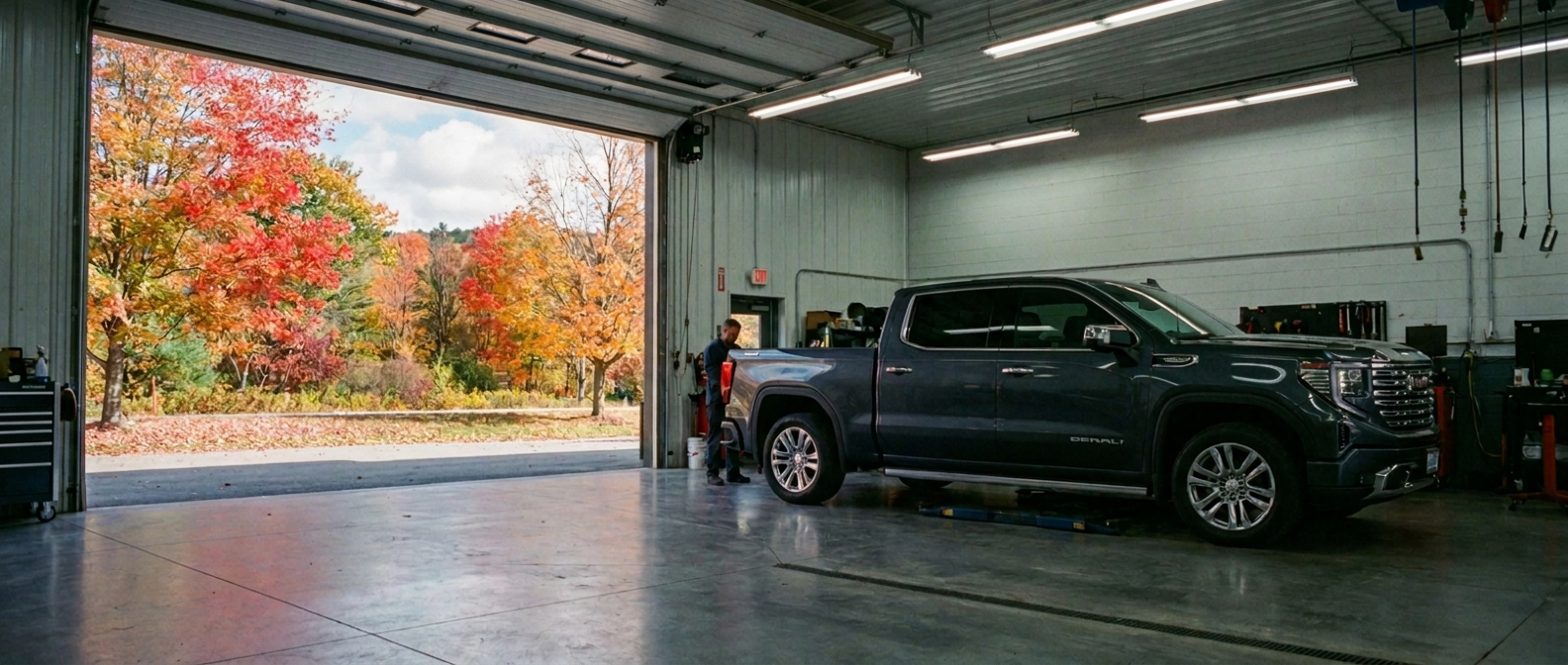
Route 9 west of Brattleboro climbs into the Green Mountain National Forest, topping out near the Hogback Mountain overlook at roughly 2,400 feet. In late September the drive is gorgeous. The same road is also a sustained descent that asks your brakes a real question, especially once the temperature drops and the pavement turns damp. What your truck or SUV gives back on that grade depends on what you've done with the last warm weeks of the year.
One service visit gives you four inspection stops and a clear picture of where your brakes stand before October gets serious. Schedule it at our Brattleboro service bay, and we'll walk you through all four. One visit does it.
What's the Route? The Four-Stop Inspection Itinerary
The table below is your shorthand, and the numbered sections that follow give you the why behind each stop, so you'll know what our technicians are actually looking for and what it means for your specific use case.
| Stop | What We Inspect | What We Measure or Check | What to Tell Us |
|---|---|---|---|
| 1. Pads | Friction material remaining, wear-indicator contact | GM service spec: replace at 2.0 mm or less of remaining friction material | How you drive: city stop-and-go, mountain runs, or towing |
| 2. Rotors | Thickness, surface condition, runout | Minimum discard thickness stamped on the rotor; runout measured with a dial gauge | Any pulsation or vibration you've felt under braking |
| 3. Brake Fluid | Moisture content, color, reservoir level | DOT 3 dry boiling point: at least 401 degrees Fahrenheit new; moisture degrades that threshold significantly | When the fluid was last changed; whether you tow or haul regularly |
| 4. Calipers and Hardware | Piston movement, slide pins, hoses | Caliper must move freely; hoses inspected for cracks or swelling | Any pulling to one side when you brake |
Stop 1: Brake Pads
Below 2.0 mm of friction material remaining, the pads need to come off, and that figure comes straight from GM's published service information. We use that threshold on every Sierra, Yukon, Terrain, and Acadia that rolls through our bay, whether it's commuting or towing.
The nuance a generic checklist won't mention comes down to GM's Brake Pad Life Monitor, built into many current GMC vehicles. It uses front and rear thickness sensors to estimate wear and posts a message in the Driver Information Center when service is needed. The monitor is genuinely useful, but it's still an estimate. It doesn't replace a physical measurement at the wheel. It can't catch uneven wear.
Uneven wear is the part worth understanding here. On trucks that tow or haul regularly, the inner pad on a front corner can wear out while the outer pad still has life. Sierra 1500 owners who put real weight behind their hitch should ask for a pad measurement at every oil change, not just when the monitor chirps. You won't see that corner wearing until we pull the wheel.
Fall is the right time to catch thin pads, because the alternative is catching them in February. On wet pavement, stopping distance grows as pad material shrinks, and that's not a trade you want on a downhill. Getting ahead of it now is easy.
Seasonal Timing Note: Vermont's annual state safety inspection checks brake condition. If your sticker is due before April, a fall brake inspection covers both bases in one visit.
Stop 2: Rotors
Pulsation in the brake pedal or steering wheel is usually the tell that a rotor surface has developed thickness variation, which GM service documentation caps at no more than 0.001 inches. If you've felt a shimmy under hard braking, that's the number in play.
Every rotor carries a minimum discard thickness stamped on it. Our technicians measure with a micrometer at four or more evenly spaced points around the friction surface. A rotor below its discard thickness can't manage heat properly, and it needs replacing, full stop. One above discard but with surface scoring or light variation might be a candidate for resurfacing, provided enough material remains to refinish safely.
For the Yukon and Yukon XL families, this stop deserves extra time. Larger, heavier vehicles put higher thermal loads through their rotors, and rear pad wear rates can differ from fronts depending on load distribution. We won't skip the rear axle. We check both axles on every inspection.
Resurfacing carries an honest tradeoff. It removes material and brings the rotor closer to its discard limit. On a truck with another three or four years of hard use ahead of it, new rotors often make more economic sense than surfacing a rotor that'll need replacing a year later anyway. We'll tell you where yours stand and let you decide.
Stop 3: Brake Fluid
Brake fluid earns the clearest performance argument for a fall service, before the mountain runs get cold, because it degrades in a way that shows up worst on a long, hot descent. You're better off getting ahead of it in September than discovering it on a grade.
Brake fluid is hygroscopic. That means it absorbs moisture from the air over time, and the U.S. Department of Transportation sets minimum boiling point standards for exactly this reason. Fresh DOT 3 fluid must meet at least 401 degrees Fahrenheit dry. Fresh DOT 4 must meet at least 446 degrees Fahrenheit dry. The problem is what that moisture does, because it drops those thresholds and you can't see it happening. A 3% water content in DOT 3 fluid can push its effective boiling point down by roughly 25%, per DOT-cited engineering data. At low temperatures, that absorbed moisture can impede fluid flow through the system entirely.
Sierra 2500 HD and 3500 HD owners who tow heavy loads on mountain grades are running their brake fluid at elevated temperatures on every descent. They're heating it and cooling it on repeat. If that fluid has picked up moisture over two or three seasons of New England humidity, its effective boiling point sits lower than the label on the reservoir suggests. A brake fluid check in September is the practical response to that reality, not a precaution for its own sake.
Dark or cloudy fluid is a clear signal. Don't ignore it. A spongy pedal feel (especially after repeated braking) can point to vapor in the lines from a fluid boiling at lower temperatures than it should. Both are worth taking seriously before the grades get slippery.
The U.S. Department of Transportation requires DOT 3 brake fluid to maintain a minimum dry boiling point of 401 degrees Fahrenheit; moisture absorption of just 3% can reduce effective boiling point by roughly 25%, a threshold that matters most on repeated downhill grades.
Schedule Your Fall Brake Inspection
Stop 4: Calipers and Hardware
Calipers rarely fail in one dramatic moment; they drift slowly, and a piston that isn't releasing cleanly keeps the pad in partial contact with the rotor, cooking one corner and wearing that pad faster than its partner. The result is uneven wear you might not catch until we put a micrometer on it.
Slide pins and guide hardware matter just as much. In southern Vermont's climate, road salt gets into everything by February, and nothing we do stops that. That salt works on the pins all winter, and by the following fall they may not be moving freely. A dragging caliper pulls the truck to one side under braking and overloads that corner. You'll feel it in the wheel.
Rubber brake hoses deserve a look at the same visit. They don't last forever, and a hose with internal swelling or cracking can restrict fluid flow even when everything else in the system is fine. Vermont inspections cover brake hoses as part of the brake system check, so catching a problem here now prevents a rejection sticker later.
Tweak It to Your Crew
The four stops apply to every GMC we service. What gets the most scrutiny, though, depends on how you're using the truck.
If you tow or haul regularly (contractors, landscapers, or anyone running a trailer on Route 9 or I-91), ask for a pad measurement at every oil change and a fluid check every two years at a minimum. Thermal load is higher on every stop, so intervals that work for a commuter don't translate.
If you're in a crossover (Terrain or Acadia, mostly highway and Putney Road commuting), the four stops still apply, but you're likely within normal service intervals. The caliper and fluid check matter most here, because these vehicles sit longer between hard braking events, and that's exactly when a caliper tends to develop a sticky piston.
If you run a commercial vehicle (Savana Cutaway 4500 and similar), brake condition is a DOT compliance item, not just a maintenance preference. Vermont's commercial vehicle inspection standards include brake adjustment as a primary out-of-service criterion. A fall inspection keeps you ahead of that. You don't want a surprise at roadside.
Acadia and Terrain owners, your inspection is quick and straightforward. Come in before the foliage crowds Route 9, and you'll be sorted in under an hour.